 listicle
7 Best Post-Workout Stretching Routines for Injury Prevention
Table of Contents
- Why Post-Workout Stretching Matters for Injury Prevention
- How Long to Hold a Stretch After Your Workout
- Routine 1: Full-Body Stretching Routine After Workout
- Routine 2: Static Stretching Routine for Cool-Down Recovery
- Routine 3: Post-Run Stretches for Lower-Body Recovery
- Routine 4: Upper-Body and Shoulder Stretches
- Routine 5: Quick 10-Minute Post-Workout Stretch Session
- Routine 6: Full-Body Flexibility and Mobility Stretch
- Frequently Asked Questions
Last Updated: October 10, 2026
Why Post-Workout Stretching Matters for Injury Prevention
Post-workout stretching routines are essential for anyone serious about fitness longevity. After intense exercise, your muscles are warm, pliable, and primed for lengthening, making post-workout stretching routines your best window for improving flexibility and preventing injury.
How Flexibility Deficits Lead to Injury
When muscles remain chronically shortened after workouts, they restrict your range of motion and alter movement patterns, forcing other joints to compensate. For example, tight hip flexors limit hip extension, causing your lower back to arch excessively during running or squatting, increasing disc pressure and injury risk. Tight hamstrings pull your pelvis into a posterior tilt, reducing spinal stability.
Research from Harvard Health Publishing on stretching routines emphasizes that consistent post-workout stretching contributes to injury prevention, improved posture, and reduced muscle soreness. The mechanism is straightforward: restoring your muscles to their resting length after exercise reduces the chronic tension that drives compensation patterns. This is especially important for people returning to fitness after time away, because deconditioning often leaves muscles tighter and movement patterns less efficient, stretching helps reset both.
Static Stretching During Cooldown
Static stretching during cooldown reduces muscle tightness when your muscles are warm and your nervous system is receptive. Holding a stretch for 20 to 60 seconds signals your nervous system to relax the muscle's protective contraction through autogenic inhibition, training it to accept greater range of motion as normal and reducing injury risk.
Gentle, controlled stretching signals safety to your nervous system and allows lasting flexibility gains. Forcing or bouncing triggers your muscle's protective reflex and can cause micro-tears.
How Long to Hold a Stretch After Your Workout
The ideal hold time for post-workout static stretching is 20 to 60 seconds per stretch, starting at 20 to 30 seconds and progressing as flexibility improves.
Holding longer than necessary doesn't yield better results. In fact, research from a 2025 consensus study on stretching recommendations found that for acute range-of-motion improvement, stretches lasting 5 to 30 seconds are effective when performed consistently. For chronic flexibility goals, the panel advised static stretching over dynamic stretching, with 2 to 3 sets per muscle group.
Hold each stretch for about 30 seconds and repeat 2 to 3 times for a sustainable cooldown. For intense sessions, extend holds to 45 to 60 seconds, but never bounce or force deeper.
Routine 1: Full-Body Stretching Routine After Workout
This routine targets every major muscle group and takes about 10 to 12 minutes. It's ideal after strength training, cardio, or mixed-intensity workouts because it addresses the muscles that typically tighten most.
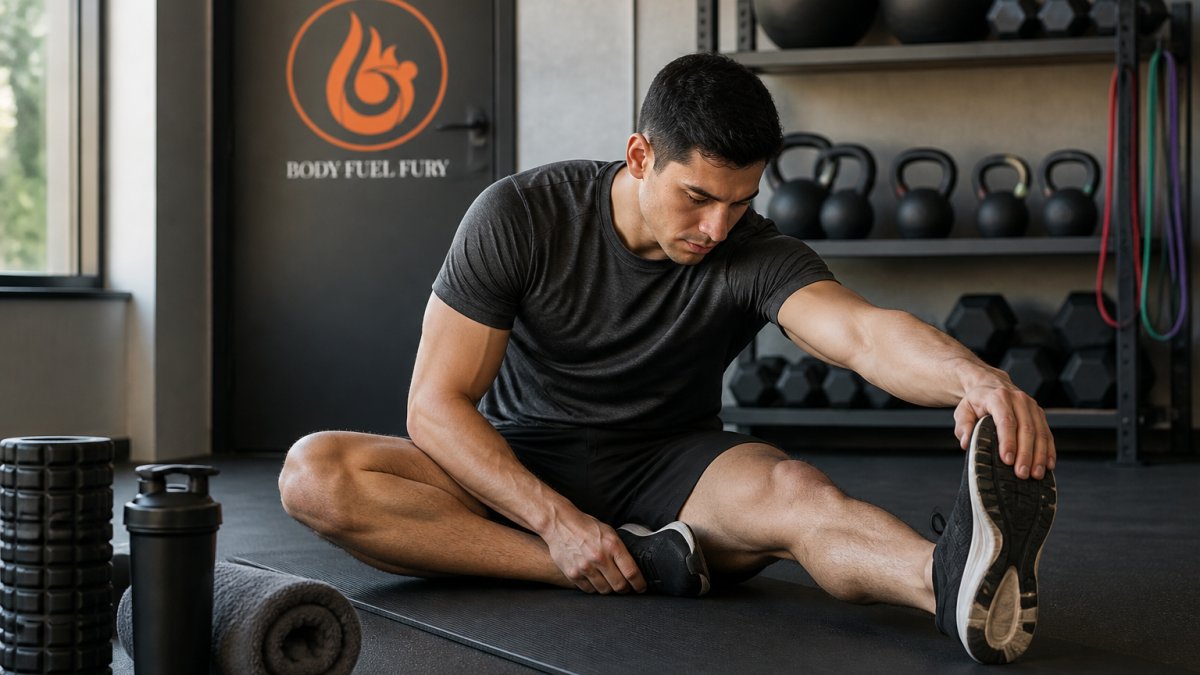
Start seated on the floor with your legs extended. Slowly hinge at the hips and reach toward your toes, not forcing, just folding forward gently. Hold for 30 seconds. This targets your hamstrings and lower back, two areas that accumulate tension quickly.
Hamstring and Lower-Body Focus
Hamstring tightness is common among active people and pulls on your pelvis and lower back, creating compensation patterns that lead to injury.
After your forward fold, move into a figure-four stretch. Lie on your back, cross one ankle over the opposite knee, and gently pull the bottom leg toward your chest. Hold for 30 seconds each side. This targets the glutes and deep hip rotators, muscles that stabilize your entire lower body.
Next, perform a quad stretch. Stand on one leg, pull your other foot toward your glute, and keep your knees aligned. Hold for 30 seconds each side. Your quadriceps are powerful muscles that can become chronically shortened from sitting and from leg-dominant exercises like squats and lunges.
Finish this section with a calf stretch. Face a wall, step one foot back, keep that heel on the ground, and lean forward gently. Hold for 30 seconds each side. Your calves tighten rapidly during running, jumping, and lower-body work, releasing them prevents ankle and knee issues.
Back and Hip Mobility
Your back and hips are interconnected; when either loses mobility, the other compensates, creating chronic pain and injury risk.
From a seated position, cross one leg over the other and gently twist your torso toward the raised knee. Hold for 30 seconds each side. This mobilizes your spinal rotation and releases your outer hip.
Follow with a Child's Pose. Kneel on the floor, sink your hips back toward your heels, extend your arms forward, and rest your forehead down. Hold for 45 seconds. This full-body stretch lengthens your back, shoulders, and hips simultaneously while calming your nervous system.
Finish with a supine twist. Lie on your back, pull one knee across your body, and let gravity do the work. Hold for 30 seconds each side. This releases spinal tension and hip tightness in a completely passive way.
Routine 2: Static Stretching Routine for Cool-Down Recovery
This 5 to 7-minute routine is ideal after moderate-intensity workouts, lighter training days, or when returning to fitness and building consistency. It targets hamstrings, hip flexors, chest, and shoulders, the muscle groups that accumulate the most tension.
The Five-Minute Essential Sequence
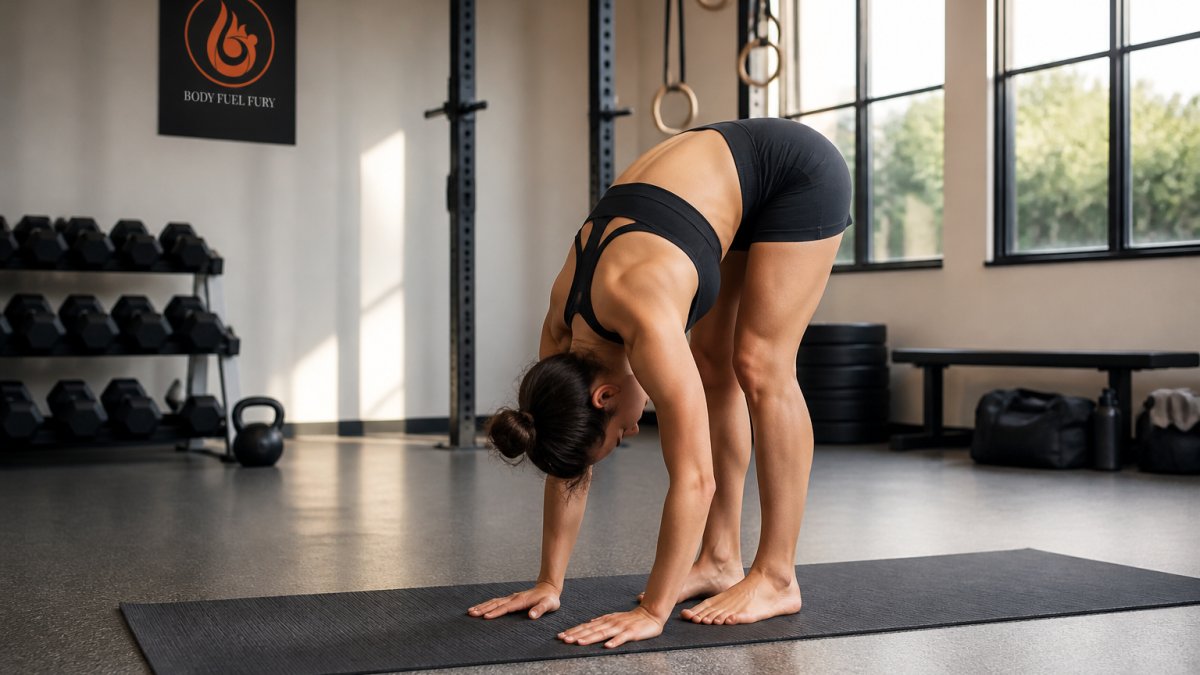
Standing Forward Fold (1 minute)
Feet hip-width apart, fold forward from the hips and let your arms hang. Hold for 30 seconds. If you feel hamstring tightness, keep your knees slightly bent. Repeat for another 30 seconds.
Low Lunge (1 minute)
Step one foot forward, lower your back knee toward the ground, and sink your hips forward gently. Hold for 30 seconds each side. This stretches hip flexors, which tighten from sitting and exercises like running and cycling. If you feel lower-back strain, reduce how far you sink your hips forward.
Chest and Shoulder Stretch (1 minute)
Clasp your hands behind your back and gently lift your chest, drawing your shoulder blades down and back. Hold for 30 seconds. This is essential for shoulder health and posture. If clasping is uncomfortable, hold a towel or resistance band between your hands instead.
Neck Stretch (1 minute)
Tilt your head toward one shoulder and apply gentle light pressure with your hand. Hold for 20 seconds each side. Never pull hard; gentle pressure prevents headaches and shoulder pain.
Supine Spinal Twist (1 minute)
Lie on your back, pull one knee across your body, and let gravity do the work. Hold for 30 seconds each side. Keep your lower back flat on the floor.
When to Use This Routine
Choose this routine when pressed for time, new to stretching, or after lighter workouts. It's ideal for active recovery days. If you're using this most days, you're building consistency, that's the win. Progress over perfection means five minutes of stretching beats skipping it entirely.
Routine 3: Post-Run Stretches for Lower-Body Recovery
Running creates specific tightness in your calves, hamstrings, hip flexors, and glutes, which need targeted attention afterward.
Begin with a standing calf stretch against a wall, stepping one foot back and leaning forward. Hold for 30 seconds each side.
Move into a standing quad stretch, pulling one foot toward your glute. Hold for 30 seconds each side.
Perform a standing hamstring stretch by placing one heel on a low bench and hinging forward gently. Hold for 30 seconds each side.
Add a standing hip flexor stretch in a lunge position, pressing your hips down gently. Hold for 30 seconds each side. Tight hip flexors limit stride length and create lower-back compensation.
Finish with a glute stretch lying on your back, crossing one ankle over the opposite knee. Hold for 30 seconds each side.
Routine 4: Upper-Body and Shoulder Stretches
Shoulder tightness affects posture, limits arm mobility, and contributes to neck and back pain.
Start with a cross-body shoulder stretch, bringing one arm across your chest and gently pulling the elbow toward your opposite shoulder. Hold for 30 seconds each side.
Move into a doorway chest stretch, placing one forearm on the frame with your elbow at shoulder height and stepping forward gently. Hold for 30 seconds each side.
Perform a triceps stretch by raising one arm overhead, bending at the elbow, and gently pulling it toward the center of your back. Hold for 30 seconds each side.
Add a shoulder blade squeeze stretch by clasping your hands in front of you, rounding your upper back, and gently pulling your hands away. Hold for 30 seconds.
Finish with a neck stretch, tilting your head toward one shoulder and applying gentle pressure. Hold for 20 seconds each side.
Routine 5: Quick 10-Minute Post-Workout Stretch Session
When time is tight, this 10-minute sequence covers all major areas: standing forward fold, low lunge, seated forward fold, figure-four stretch, Child's Pose, standing quad stretch, supine twist, cross-body shoulder stretch, doorway chest stretch, and gentle neck stretches. This routine is perfect when pressed for time but wanting to support recovery and flexibility.
Routine 6: Full-Body Flexibility and Mobility Stretch
This comprehensive routine takes about 15 minutes and is ideal for dedicated recovery days or when you want deeper flexibility work.
Start seated with your legs extended. Perform a forward fold, holding for 45 seconds. Repeat 2 times.
Move into a butterfly stretch. Sit with the soles of your feet together, knees out to the sides, and gently fold forward. Hold for 45 seconds. Repeat 2 times.
Perform a spinal twist. Lie on your back, pull one knee across your body, and hold for 45 seconds each side. Repeat 2 times.
Move into a pigeon pose. From a tabletop position, bring one leg forward with your knee near your chest, and sink your hips back gently. Hold for 60 seconds each side. This deep hip stretch is excellent for runners and anyone with tight hips.
Perform a supine hamstring stretch. Lie on your back, loop a towel around one foot, and gently pull your leg toward your chest. Hold for 45 seconds each side. Repeat 2 times.
Add a quad stretch. Stand on one leg, pull your other foot toward your glute, and hold for 45 seconds each side. Repeat 2 times.
Finish with a full-body Child's Pose. Hold for 90 seconds, breathing deeply and allowing your entire body to relax.
Post-workout stretching isn't optional if you want to stay injury-free and improve your long-term athletic performance. The routines above are designed for different situations, quick cooldowns, targeted recovery, and deeper flexibility work. Body Fuel Fury supports your fitness journey with high-quality recovery tools and supplements that work alongside consistent stretching to keep you healthy and performing at your best. Explore our full range of recovery essentials and find exactly what your training needs.
Frequently Asked Questions
Which type of stretching is recommended after a workout?
Static stretching is the best choice for post-workout recovery. Unlike dynamic stretching used before exercise, static stretching involves holding a position for 20-30 seconds without bouncing. This approach helps ease tight muscles, improve range of motion, and support recovery after your training session.
How long should you hold a post-workout stretch?
Hold each stretch for 20-30 seconds, repeating 2-3 times per muscle group. Research supports this duration for improving flexibility and mobility after exercise. Avoid bouncing or forcing the stretch; instead, ease into the position with controlled breathing and gentle pressure.
Does stretching after a workout really help prevent injuries?
Yes, post-workout stretching supports injury prevention by improving flexibility, maintaining range of motion, and reducing muscle tightness. Regular stretching as part of your cool-down routine helps your body recover more effectively and prepares your muscles for future training sessions.
Can stretching help with post-workout stiffness and soreness?
Stretching after exercise can help reduce muscle stiffness and ease tightness that develops during recovery. A consistent post-workout stretching routine supports better mobility the next day and may reduce the sensation of soreness, making it easier to return to training.