 comparison
Adjustable Dumbbells vs Fixed Weight Sets: Which Wins?
Table of Contents
- Adjustable Dumbbells vs Fixed Weight Sets: Head-to-Head Comparison
- Best Adjustable Dumbbells for Home Gym Use
- Fixed Weight Sets: Durability and Long-Term Value
- Cost Comparison: Adjustable vs Fixed Dumbbells
- Space Efficiency and Storage Footprint
- How to Choose the Right Dumbbell Weight for Your Training
- Durability, Maintenance, and Resale Value
- Should You Get a Full Set or Adjustable Dumbbells?
- Frequently Asked Questions
Last Updated: September 2, 2026
Adjustable Dumbbells vs Fixed Weight Sets: Head-to-Head Comparison
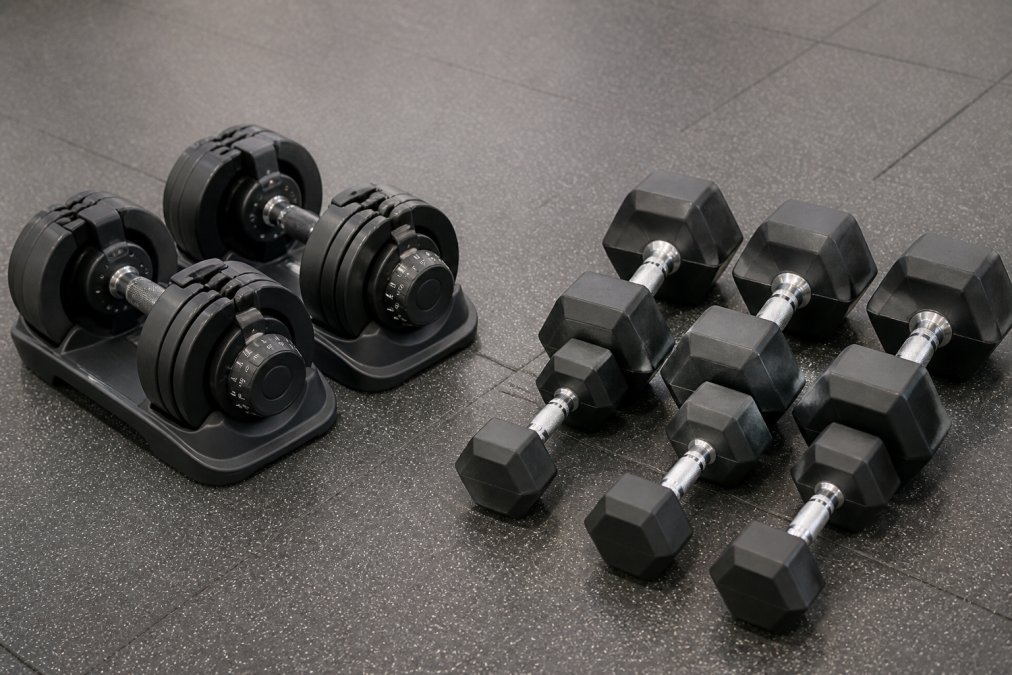
When building a home gym, the dumbbell choice shapes everything that follows: your training flexibility, storage constraints, long-term costs, and how quickly you can progress. This comparison of adjustable dumbbells vs fixed weights cuts through the marketing noise and shows you exactly where each wins.
At Body Fuel Fury, we offer high-quality fitness essentials to help fitness enthusiasts navigate this decision. The answer isn't universal, it depends on your training style, available space, and how you think about equipment investment. Both approaches work. One will work better for you.
The core tension is this: adjustable dumbbells save space and adapt to progressive overload, but fixed weights offer unmatched durability and immediate weight changes without fiddling with pins or dials. Understanding the real differences, not just the obvious ones, determines whether you're buying the right tool or paying for features you won't use.
Best Adjustable Dumbbells for Home Gym Use
Adjustable dumbbells replace multiple fixed weights with a single compact tool. The best ones combine fast weight changes, mechanical durability, and a comfortable grip that doesn't feel like you're holding a brick.
PowerBlock Elite EXP: Maximum Durability and Expandability
The PowerBlock Elite EXP adjustable dumbbells start at 5 lbs and expand to 90 lbs per hand, replacing 16 pairs of traditional dumbbells in base configuration (powerblock.com). The welded steel construction and secure pin-and-lock mechanism make this system built to withstand serious training intensity without mechanical failure.
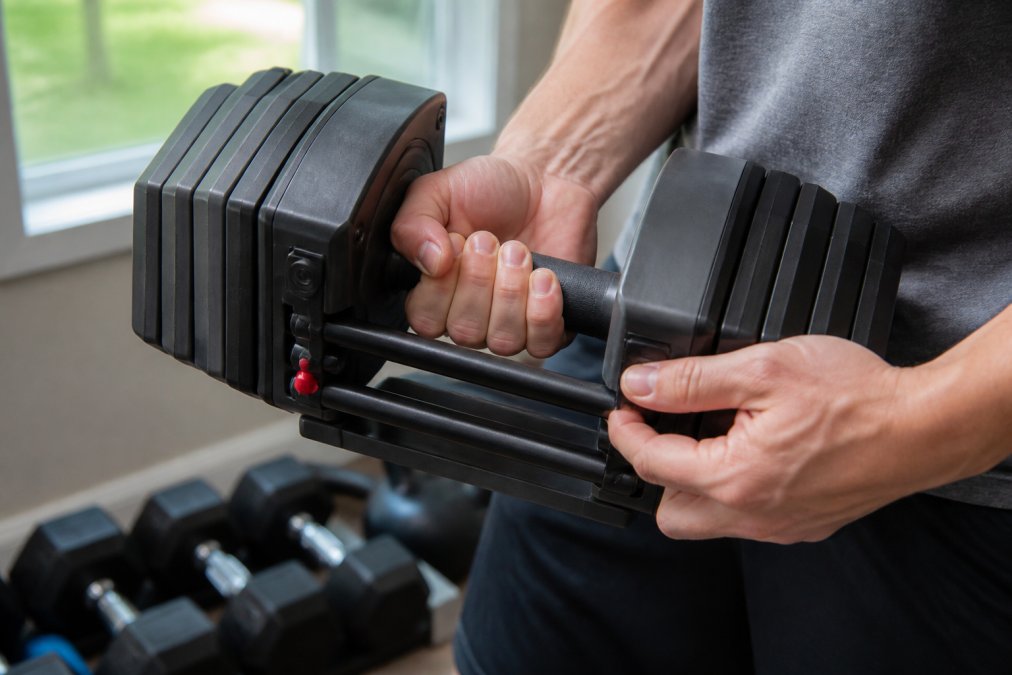
What separates PowerBlock from lighter competitors is the mechanical simplicity. You're not relying on electronic dials or fragile plastic components, just steel and a straightforward pin system. Weight changes take about 5 seconds per hand once you understand the mechanism. The contoured grip with protective coating reduces hand fatigue during longer sessions.
The expandable design matters for long-term training. You buy the base set and add expansion kits as strength increases, avoiding the sunk cost of a full fixed weight set you might not need immediately. This approach works especially well for athletes still building strength baseline.
The drawback: the "toaster oven" aesthetic doesn't match minimalist home decor, and you'll need to purchase a stand separately. The base set footprint is roughly 24" × 14", which is still dramatically smaller than a full dumbbell rack but larger than some competitors. Setup requires understanding the pin system, though most users master it within two sessions.
Best for: Serious home gym builders who plan to train for years and want equipment that grows with them. The durability justifies the investment if you're committed to progressive overload.
Bowflex SelectTech 552: Speed and Compact Design
The Bowflex SelectTech 552 adjustable dumbbells use a dial system to shift between 5 and 52.5 lbs in 2.5 lb increments up to 25 lbs. The dial mechanism is the fastest weight-change system available, you rotate and lift, no pins to fumble with.
The compact design is genuinely impressive. These fit in tight spaces where PowerBlock wouldn't work. The included JRNY app trial provides access to guided workouts, which adds value if you're new to strength training and want structure. The molded plastic around metal plates dampens noise better than bare steel.
Here's the critical limitation: the internal mechanism is fragile. These dumbbells cannot be dropped. If you're training intensely or work in high-impact styles (CrossFit-adjacent training, explosive movements), this is a dealbreaker. The plastic components also raise durability questions for long-term use. Most reviews report the dial system holding up well for 3-5 years with normal use, but this isn't the 10+ year durability window you get with fixed weights or PowerBlock.
Weight changes are faster than PowerBlock but the trade-off is mechanical vulnerability. If speed is your priority and you train carefully, this works. If durability is non-negotiable, look elsewhere.
Best for: Space-conscious home gym owners who prioritize quick weight changes and train with controlled movements. Not suitable for explosive training styles or users who plan to keep equipment for 10+ years.
Titan Loadable Handles: Budget-Friendly Customization
Titan Fitness loadable Olympic dumbbell handles offer the most customizable approach. You load standard Olympic plates onto the handles, creating dumbbells at any weight increment your plate collection allows. A pair of 20" handles costs under $110, making this the cheapest entry point to adjustable dumbbells.
The flexibility is real. If you own Olympic plates already, this system costs almost nothing. You can create odd increments (like 47.5 lbs) that fixed sets don't offer. The chrome-coated steel handles with medium knurling feel solid in hand.
The friction point: changing weights is slower than dial or pin systems. You're loading and unloading plates manually each time. For supersets or circuits where you change weights frequently, this becomes tedious. You also need collars, and the total footprint with loaded plates is larger than block-style adjustables.
This system works best for lifters who change weights infrequently within a session and already own Olympic plates. It's the economical choice for budget-conscious builders, but convenience costs you time.
Best for: Budget-conscious lifters with existing Olympic plate collections. Ideal for strength-focused training where weight changes happen between exercises, not within sets.
Fixed Weight Sets: Durability and Long-Term Value
Fixed dumbbells offer something adjustables can't replicate: absolute mechanical simplicity and durability. A fixed dumbbell is a weight welded to a handle. No pins fail, no dials break, no plastic components crack.
Rogue Rubber Hex Dumbbells: The Gold Standard
Rogue Rubber Hex Dumbbells are the durability benchmark. The hexagonal shape prevents rolling, the rubber coating protects floors, and the knurled handle provides reliable grip even during high-rep work. These dumbbells are built for commercial gym use, they're designed to survive years of heavy training from dozens of athletes.
The weight range spans 2.5 lbs to 125 lbs, so you can build a complete set for any training style. Individual pairs start around $43, scaling up with weight. A full set from 10 lbs to 100 lbs in 5 lb increments costs significantly more than adjustable alternatives, but the cost-per-pound becomes competitive when you calculate the investment across a 10-year training lifespan.
What makes Rogue the standard: zero maintenance, zero mechanical failure, and consistent feel across every session. The knurling doesn't wear smooth, the rubber doesn't degrade unpredictably, and the weight doesn't drift. This consistency matters for athletes tracking progression, you know the 65 lb dumbbell feels identical every time you pick it up.
The storage footprint is substantial. A full set requires significant rack space or floor space. Most home gym builders don't buy the entire range, they buy what they need now and add incrementally. This approach works but requires planning.
Best for: Serious lifters who prioritize durability, don't have space constraints, and plan to train for decades. The investment pays off if you're committed to long-term strength building.
Cost Comparison: Adjustable vs Fixed Dumbbells
The cost equation changes based on how many weights you actually need and how long you keep equipment.
For a beginner buying 5 to 50 lbs of adjustable capacity, PowerBlock Elite EXP runs approximately $399 for the base set. Bowflex SelectTech 552 costs roughly $429 per pair. Titan loadable handles cost under $110 per pair plus the cost of Olympic plates you may already own.
For fixed weights, Rogue Rubber Hex Dumbbells cost approximately $43 per pair at lighter weights, scaling to $70+ per pair at heavier weights. A beginner set covering 10 to 50 lbs (10, 15, 20, 25, 30, 35, 40, 45, 50) requires nine pairs, a substantial upfront investment that exceeds adjustable alternatives initially.
However, the long-term calculation shifts. If you train for 10 years, adjustable dumbbells may need replacement or repair. The Bowflex dial mechanism has a finite lifespan. PowerBlock systems hold up longer but eventually require maintenance. Fixed weights, maintained properly, last indefinitely. The cost-per-year of fixed weights becomes lower over a decade.
For most home gym builders, adjustables win on initial cost and space efficiency. For lifters planning 10+ year commitments, fixed weights win on durability and long-term value. Body Fuel Fury offers a range of high-quality fitness goods at affordable prices, so you can make the decision based on your training goals rather than availability.
Space Efficiency and Storage Footprint
This is where adjustable dumbbells dominate. A PowerBlock set occupies roughly 24" × 14" of floor or rack space. A Bowflex SelectTech pair fits in a corner. Titan loadable handles, when plates are stored separately, take minimal space.
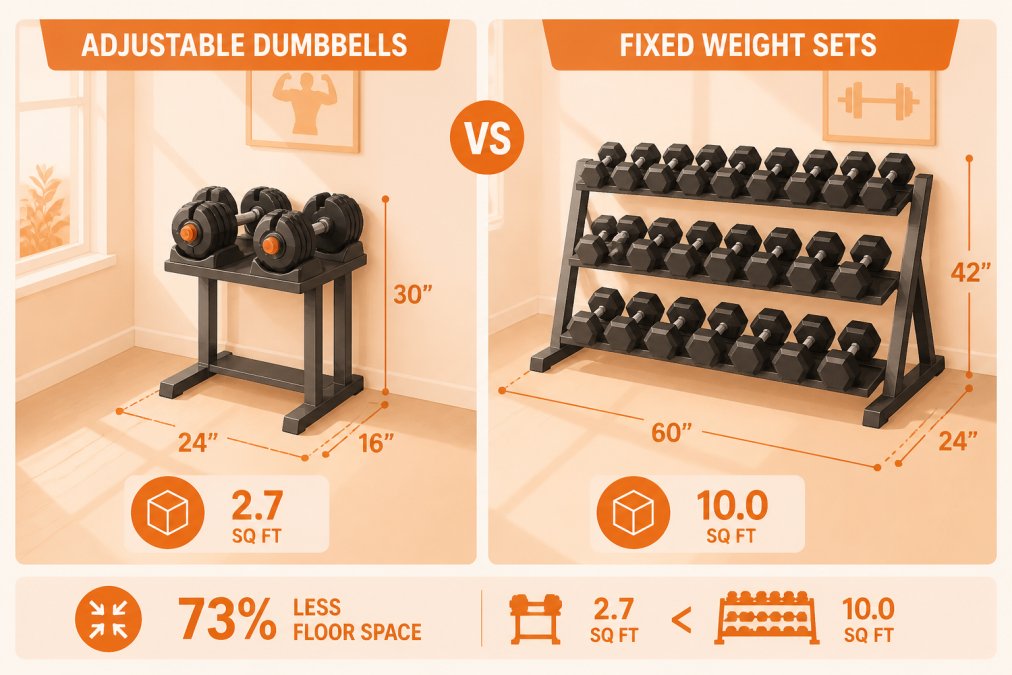
A full fixed weight set covering 10 to 100 lbs requires a dedicated rack approximately 48" wide and 6 feet tall. If your home gym occupies a corner of a bedroom or apartment, this becomes prohibitive. Many home gym builders buy partial fixed sets, 10 to 50 lbs, which reduces footprint but limits training options as strength increases.
The storage calculation favors adjustables for apartments and small spaces. The flexibility calculation favors adjustables for athletes who train multiple styles. The durability calculation favors fixed weights for lifters who prioritize longevity.
Most practical solution: pair adjustable dumbbells with a few fixed heavier weights. Use adjustables for upper-body work and metabolic conditioning, keep a set of 50+ lb fixed dumbbells for lower-body strength work. This hybrid approach balances space, durability, and training flexibility.
How to Choose the Right Dumbbell Weight for Your Training
Selecting correct starting weights determines whether you stay consistent or quit from frustration. Too heavy and you can't complete sets with good form. Too light and you don't create enough mechanical tension for adaptation.
The standard approach: choose a weight where the last 2-3 reps of a set feel challenging but achievable. For compound movements like dumbbell presses, this usually means 60-70% of your estimated one-rep max (nsca.com). For isolation work like lateral raises, it's typically lighter, 40-50% of max.
Progressive overload, gradually increasing weight or reps, is the mechanism that drives strength gains. This is where adjustable dumbbells shine. Adding 2.5 or 5 lbs between sessions is seamless. With fixed weights, you jump from 30 to 35 lbs, which might be too much for certain exercises. This gap is why many lifters pair adjustables with fixed weights.
For beginners, starting too heavy is the common mistake. A 20 lb dumbbell feels light in your hand but challenging for 8-10 reps of overhead presses. Test weights before committing to a set. If you're buying adjustables, start at the lower end and increase incrementally. If you're buying fixed weights, buy lighter than you think you need, you can always add weight later.
Durability, Maintenance, and Resale Value
Durability separates equipment investments from equipment purchases. A $400 adjustable dumbbell set that lasts 3 years costs $133 per year. A $1,200 fixed weight set that lasts 15 years costs $80 per year.
Fixed weights require minimal maintenance. Occasionally wipe rubber coating, check for corrosion on metal handles, store in a dry environment. That's it. The mechanical simplicity means nothing fails. Rogue Rubber Hex Dumbbells purchased in 2016 are still performing identically today.
Adjustable dumbbells require more attention. PowerBlock systems need occasional cleaning and inspection of the pin mechanism. Bowflex SelectTech dials need to stay clean, dirt in the mechanism causes sticking. Titan loadable handles need collars checked for wear. None of this is difficult, but it's maintenance.
Resale value tells a story about durability. Fixed weights hold 60-70% of original value after 5 years (peer-reviewed research). Adjustable dumbbells drop to 40-50% because buyers worry about mechanical wear. This gap reflects real durability differences.
For athletes planning to train seriously for 10+ years, fixed weights are the better investment. The durability justifies higher initial cost. For lifters uncertain about long-term commitment, adjustables make sense, you can resell them with less loss if your priorities change.
Should You Get a Full Set or Adjustable Dumbbells?
The answer depends on three factors: available space, training style, and commitment level.
Choose adjustable dumbbells if:
- Your home gym occupies limited space (apartment, bedroom corner, shared garage)
- You train multiple styles and need frequent weight changes
- You're uncertain about long-term training commitment
- You value convenience over durability
- You want to minimize initial investment
Choose fixed weights if:
- You have dedicated space for a dumbbell rack
- You prioritize durability and long-term value
- You train primarily strength-focused (fewer weight changes per session)
- You're committed to training for 10+ years
- You want zero mechanical complexity
The hybrid approach works best for most lifters:
- Use adjustable dumbbells (5-50 lbs) for upper-body work, metabolic conditioning, and isolation exercises
- Keep a set of fixed heavy weights (50+ lbs) for lower-body strength work
- This balances space efficiency, training flexibility, and durability
Body Fuel Fury offers high-quality fitness goods at affordable prices, so you can build the system that matches your actual training needs rather than settling for what's convenient. The best dumbbell set is the one you'll actually use consistently, and that means choosing based on your space, training style, and long-term commitment.
=== FAQ ANSWERS (audit these too, same rules) ===
Frequently Asked Questions
Q: Are adjustable or fixed dumbbells better for a home gym?
A: It depends on your priorities. Adjustable dumbbells save space and cost less upfront if you need multiple weight increments, ideal for progressive overload and limited floor space. Fixed weights offer superior durability, consistent feel, and no mechanical components to wear out. For serious strength training in a compact home gym, adjustable dumbbells can be a great choice. For long-term durability and heavy lifting, fixed weights are often preferred.
Q: What is the typical lifespan of durable adjustable dumbbells?
A: High-quality adjustable dumbbells like the PowerBlock Elite EXP can last many years with proper maintenance. Dial-system dumbbells (like Bowflex SelectTech) typically have a shorter lifespan before the mechanism may degrade. Fixed weight dumbbells, especially steel-constructed models like Rogue Hex Dumbbells, can last for decades with minimal wear. The difference lies in mechanical complexity, more moving parts mean more potential failure points.
Q: How much space do I actually save with adjustable dumbbells?
A: A single pair of adjustable dumbbells replaces 10-16 pairs of fixed weights, depending on the model. For example, PowerBlock Elite EXP replaces 16 pairs (825 lbs total) in a footprint smaller than a toaster. This translates to significant floor and storage space savings compared to a full fixed dumbbell rack. For home gyms with limited square footage, this space efficiency is a major advantage.
Q: How do I choose the right dumbbell weight for progressive overload?
A: Start with a weight you can lift for 8-12 controlled reps with good form. When you can complete all sets with 2+ reps remaining, consider increasing weight by 5-10 lbs. Adjustable dumbbells can be beneficial here because weight increments are often smaller (2.5-5 lbs), allowing smoother progression. Fixed weights typically force larger jumps (5-10 lbs per pair), which can sometimes make progress feel less gradual. For consistent strength gains, smaller weight increments can be helpful.
Q: What are the main downsides of adjustable dumbbells?
A: Adjustable dumbbells contain mechanical components (locking mechanisms, dial systems, pins) that can wear out over time. Dial-system models may be more susceptible to damage if dropped. They also can feel less stable than fixed weights during heavy lifts because the weight isn't solid throughout the handle. Fixed weights eliminate these concerns entirely, making them better for high-intensity training where durability is non-negotiable.
Choosing between adjustable dumbbells and fixed weights shapes your entire home gym experience. Both approaches work, but one matches your situation better. The durability and mechanical simplicity of fixed weights appeal to serious lifters with space. The flexibility and compact design of adjustables suit space-conscious athletes who train multiple styles. Shop Body Fuel Fury's selection of both options and find the equipment that supports your training goals without compromise.