 blog
10 Home Gym Exercises for Muscle Growth
Table of Contents
- Why Home Gym Exercises Work for Muscle Growth
- The 10 Best Home Gym Exercises for Building Muscle
- 1. Push-Ups: The Foundation Upper-Body Exercise
- 2. Goblet Squats: Lower-Body Strength and Size
- 3. Dumbbell Rows: Back and Bicep Development
- 4. Lunges: Single-Leg Lower-Body Power
- 5. Planks and Variations: Core Strength and Stability
- 6. Dumbbell Shoulder Press: Shoulder and Tricep Growth
- 7. Glute Bridges: Posterior Chain Development
- 8. Jumping Lunges: Explosive Lower-Body Training
- 9. Tricep Dips: Upper-Body Pressing Power
- 10. Assisted Bodyweight Squats: Foundational Leg Training
- Sets and Reps for Muscle Growth at Home
- Progressive Overload at Home: Building Strength Over Time
- Home Workout Routine for Muscle Gain: Full-Body Programming
- Home Gym Equipment for Strength Training and Beyond
- Common Mistakes That Slow Muscle Growth at Home
- Recovery, Nutrition, and Realistic Expectations
- Frequently Asked Questions
Last Updated: October 6, 2026
Why Home Gym Exercises Work for Muscle Growth
Building muscle at home is achievable without a gym membership or expensive equipment, and home gym exercises muscle growth is proven through progressive resistance and consistent effort.
Muscle growth happens when you challenge muscles with resistance and allow recovery. Whether using dumbbells, bodyweight, or improvised weights, the science is the same: progressive overload and proper form drive results.
The most successful focus on compound movements, progressive overload, and realistic expectations, progress takes time, but consistency pays off.
The 10 Best Home Gym Exercises for Building Muscle
These 10 exercises form the foundation of any home gym workout, and home gym exercises muscle growth through compound movements that target all major muscle groups. They target all major muscle groups, require minimal equipment, and can be modified for any level.
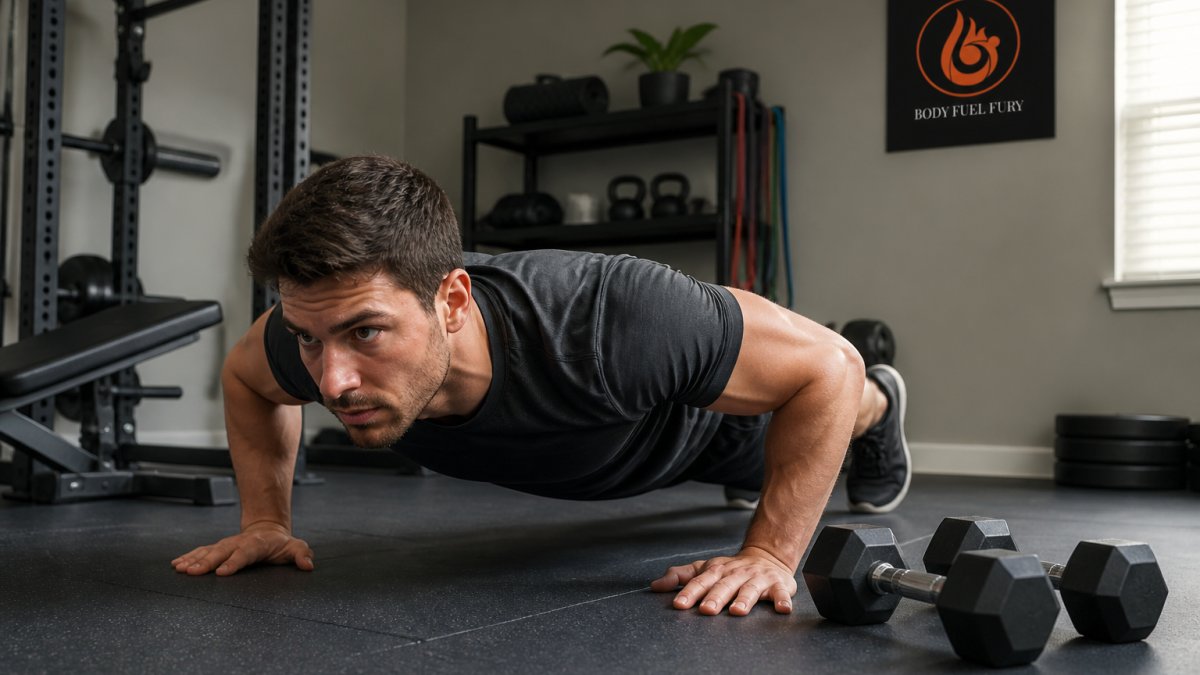
1. Push-Ups: The Foundation Upper-Body Exercise
Push-ups are one of the most effective bodyweight exercises for chest, shoulders, and triceps, requiring zero equipment.
How to perform a push-up:
- Start in a plank position with hands slightly wider than shoulder-width
- Keep your chest up and back straight
- Lower your body until your chest nearly touches the floor
- Push back to the starting position
- Complete 8 to 12 reps per set
Beginners can start with knee or wall push-ups; advanced lifters can add resistance with a weighted vest or a dumbbell on their back.
2. Goblet Squats: Lower-Body Strength and Size
Goblet squats are one of the best home gym exercises for lower-body muscle growth, simple to learn and effective for legs and glutes.
How to perform a goblet squat:
- Hold a dumbbell vertically against your chest with both hands
- Stand with feet shoulder-width apart
- Lower your body by bending your knees and hips
- Keep your chest up and weight in your heels
- Squat until your thighs are parallel to the floor
- Push through your heels to stand back up
The dumbbell in front keeps your chest upright and prevents excessive forward lean, teaching proper squat form better than any other variation.
3. Dumbbell Rows: Back and Bicep Development
Rows build a strong, muscular back, work your biceps, and improve posture, perfect for home gym training.
How to perform a dumbbell row:
- Bend forward at the hips until your torso is nearly parallel to the floor
- Let dumbbells hang at arm's length
- Pull the dumbbells toward your hips, squeezing your shoulder blades together
- Lower the dumbbells back down in a controlled manner
- Complete 8 to 12 reps per set
Keep your back straight throughout; the power comes from your back muscles, not your arms.
4. Lunges: Single-Leg Lower-Body Power
Lunges build strength in each leg individually, fixing muscle imbalances and improving single-leg stability.
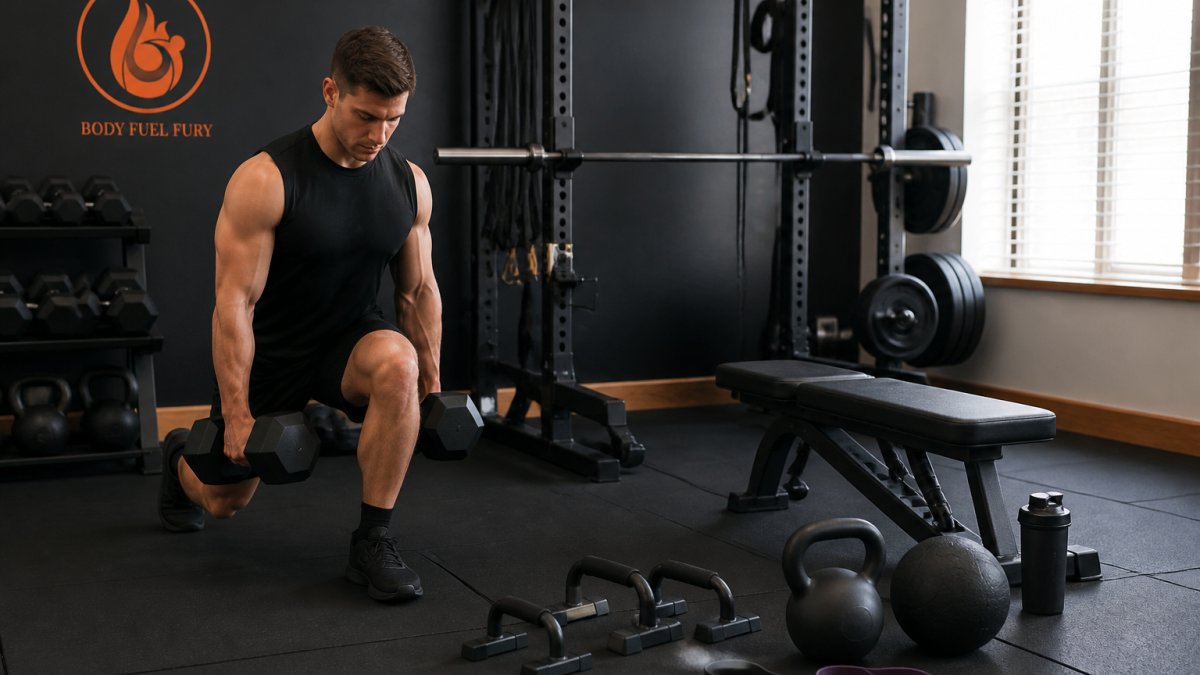
How to perform a lunge:
- Stand with feet hip-width apart
- Step forward with one leg
- Lower your body until both knees are bent at roughly 90 degrees
- Push through your front heel to return to the starting position
- Alternate legs for 8 to 12 reps per leg
Do them with bodyweight or dumbbells; they work the quads, glutes, and hamstrings.
5. Planks and Variations: Core Strength and Stability
A strong core improves posture, prevents injury, and helps every other exercise. Planks are the gold standard for core training.
How to perform a plank:
- Get into a forearm plank position
- Keep your body in a straight line from head to heels
- Engage your core and don't let your hips sag
- Hold for 30-60 seconds
- Rest and repeat for 3-4 sets
As you get stronger, increase hold time or try side planks and leg lifts.
6. Dumbbell Shoulder Press: Shoulder and Tricep Growth
The shoulder press builds strong, broad shoulders and works your triceps hard. It's one of the best pressing movements for home gym training.
How to perform a dumbbell shoulder press:
- Sit or stand holding dumbbells at shoulder height
- Press the dumbbells straight overhead
- Lower them back to shoulder height in a controlled manner
- Complete 8 to 12 reps per set
Press with stability and control, no momentum.
7. Glute Bridges: Posterior Chain Development
Glute bridges target the glutes and hamstrings while being gentle on your lower back, important for balanced development.
How to perform a glute bridge:
- Lie on your back with knees bent and feet flat on the floor
- Push through your heels and lift your hips off the ground
- Squeeze your glutes at the top
- Lower your hips back down
- Aim for 8 to 12 reps per set
Add a dumbbell across your hips for extra resistance as you get stronger.
8. Jumping Lunges: Explosive Lower-Body Training
Jumping lunges build muscle while improving explosive strength and athleticism.
How to perform a jumping lunge:
- Start in a lunge position with one leg forward
- Explosively jump and switch leg positions in the air
- Land softly with the opposite leg forward
- Immediately jump again
- Complete 8 to 12 reps per leg
Best for intermediate or advanced lifters; beginners should start with regular lunges.
9. Tricep Dips: Upper-Body Pressing Power
Tricep dips build big arms and strong shoulders using a chair, bench, or dip station at home.
How to perform tricep dips:
- Place your hands on a sturdy chair or bench behind you
- Lower your body by bending your elbows
- Keep your elbows close to your body
- Push back up to the starting position
- Complete 8 to 12 reps per set
Beginners can keep feet on the floor; elevate them on another chair for more resistance as you get stronger.
10. Assisted Bodyweight Squats: Foundational Leg Training
Assisted bodyweight squats are perfect for beginners building leg strength, teaching proper form without heavy weight.
How to perform an assisted bodyweight squat:
- Hold onto something stable like a doorframe or resistance band
- Stand with feet shoulder-width apart
- Lower your body by bending your knees and hips
- Keep your chest up
- Push through your heels to stand back up
- Complete 8 to 12 reps per set
As you progress, reduce your reliance on assistance until you can do full bodyweight squats or add dumbbells.
Sets and Reps for Muscle Growth at Home
For building muscle, the magic range is 8 to 12 reps per set, enough tension and metabolic stress to stimulate growth.
Here's what you need to know:
- Reps: Choose a weight where 8 to 12 reps feels challenging but doable
- Sets: Aim for 3-4 sets per exercise
- Rest: Take 60-90 seconds between sets
- Frequency: Train each muscle group 2-3 times per week
The weight should make the last 2-3 reps difficult. If you can easily do 12 reps, increase the weight.
Progressive Overload at Home: Building Strength Over Time
Progressive overload is the foundation of muscle growth. It means gradually increasing the challenge your muscles face.
Without it, you'll plateau: your body adapts quickly, and using the same weight and reps every week stalls growth.
Ways to progress at home:
- Add more weight (use heavier dumbbells)
- Increase reps (go from 10 to 12 reps per set)
- Add more sets (go from 3 to 4 sets)
- Reduce rest time between sets
- Improve exercise form and range of motion
- Try harder variations (regular push-ups instead of knee push-ups)
Track your weight, reps, and sets, and each week try to do slightly more than the previous week.
Home Workout Routine for Muscle Gain: Full-Body Programming
A full-body home gym routine hits all major muscle groups 2-3 times per week, ideal for muscle growth.
Sample home gym workout routine:
| Exercise | Sets | Reps | Rest |
|---|---|---|---|
| Push-Ups | 3 | 8-12 | 90 sec |
| Goblet Squats | 3 | 8-12 | 90 sec |
| Dumbbell Rows | 3 | 8-12 | 90 sec |
| Lunges | 3 | 8-12 per leg | 60 sec |
| Planks | 3 | 30-60 sec | 60 sec |
Do this 3 days per week with at least one rest day between sessions, focusing on recovery and nutrition.
Intermediate lifters can split it into upper and lower body days for more volume and better recovery.
Home Gym Equipment for Strength Training and Beyond
You don't need much to build muscle at home, a few basic pieces go a long way.
Essential equipment:
- Dumbbells (adjustable sets are best)
- Resistance bands
- A sturdy chair or bench
- A pull-up bar (optional but useful)
Dumbbells are the most versatile tool, allowing progressive overload across all major exercises.
Body Fuel Fury offers high-quality dumbbells, resistance bands, and other home gym equipment designed for serious muscle builders. Whether you're just starting or returning to fitness, we have options that match your needs.
Common Mistakes That Slow Muscle Growth at Home
Most people make predictable mistakes that limit results.
Mistake 2: Poor exercise form Sloppy form reduces activation and increases injury risk.
Mistake 3: Insufficient volume 1-2 sets per exercise isn't enough. Aim for 3-4 sets.
Mistake 5: Ignoring recovery Muscles grow during rest. Sleep 7-9 hours and eat enough protein.
Mistake 6: Doing only isolation exercises Compound movements are most efficient.
Recovery, Nutrition, and Realistic Expectations
Building muscle takes time, realistic expectations keep you motivated and consistent.
Expected muscle growth timeline:
- First 4-8 weeks: Form improves, strength increases
- 8-12 weeks: Noticeable muscle size gains
- 3-6 months: Significant visible progress
- 1+ years: Substantial muscle development
Genetics play a role, but consistent effort trumps genetics every time.
Nutrition for muscle growth:
- Eat enough protein (0.7-1 gram per pound of bodyweight)
- Get adequate calories to support muscle building
- Eat whole foods most of the time
- Stay hydrated
Recovery matters:
- Sleep 7-9 hours per night
- Take rest days seriously
- Manage stress
- Listen to your body
Progress over perfection is the mindset that works.
Building muscle at home is realistic and sustainable. The 10 exercises here work all major muscle groups.
Body Fuel Fury provides everything you need to succeed: quality dumbbells, resistance bands, recovery tools, and performance supplements.
Frequently Asked Questions
Can you build muscle with home gym exercises?
Yes. Home gym exercises build muscle effectively when you use compound lifts, train with enough resistance, and maintain progressive overload. Push-ups, squats, rows, and lunges create the tension and metabolic stress needed for muscle growth. The key is consistency and challenging yourself with higher reps, more sets, or added resistance over time.
How many sets and reps should you do to build muscle at home?
Aim for 8 to 12 reps per set, completing 3 to 4 sets per exercise. This rep range is ideal for muscle growth because it combines sufficient mechanical tension with metabolic fatigue. Rest 60 to 90 seconds between sets. Beginners may start with 2 to 3 sets, while intermediate and advanced lifters can increase volume as they adapt.
What home gym equipment do you need to build muscle?
A basic setup includes dumbbells, a pull-up bar, and a bench. Dumbbells allow you to add resistance to major compound movements. A pull-up bar enables back and shoulder work. A bench supports pressing and seated exercises. Resistance bands, kettlebells, and a medicine ball are excellent additions. Bodyweight alone works for beginners, but dumbbells accelerate muscle growth by enabling progressive overload.
How do you make home workouts harder as you get stronger?
Progressive overload is essential. Increase weight by adding heavier dumbbells, add more reps or sets, reduce rest between sets, or slow down the movement tempo. You can also use exercise variations: progress from knee push-ups to full push-ups, or add jumping to lunges. These changes keep your muscles challenged and prevent plateaus.