 ultimate-guide
Bike for Workout: Best Exercise Bikes & Buying Guide
Table of Contents
- Why a Bike for Workout Beats Most Home Cardio Options
- Stationary Bike Benefits Beyond Weight Loss
- Upright vs Recumbent Bike: Which Fits Your Body and Goals
- Key Features to Compare Before You Buy
- Indoor Cycling Workout Routine for Any Fitness Level
- Exercise Bike Maintenance Tips for Years of Quiet Operation
- Frequently Asked Questions
Last Updated: September 19, 2026
Why a Bike for Workout Beats Most Home Cardio Options
A bike for workout delivers one of the highest-value combinations in home fitness: low joint stress, scalable intensity, and a machine that lasts years with basic care. This guide breaks down how to choose one, set it up correctly, and keep it running quietly.
Low-Impact Cardio That Protects Your Joints
Low-impact cardio is exercise that raises your heart rate without driving repeated force through your knees, hips, and ankles. Cycling qualifies because your feet stay supported by the pedals while the flywheel absorbs the resistance.
Calorie Burn and Aerobic Capacity in 30 Minutes
Thirty minutes on a bike for workout purposes is enough to build real aerobic capacity when you structure the session. A steady moderate ride improves endurance; short hard efforts push your ceiling higher.
Stationary Bike Benefits Beyond Weight Loss
Stationary bike benefits extend well past calorie burn. Regular indoor cycling supports cardiovascular health, mood, and, most importantly, consistency, because the barrier to starting a session is so low.
Heart Health, Mood, and Consistency
Cardio training at moderate intensity strengthens the heart and improves circulation over time. The psychological side is just as real: a short ride after work clears mental fog and breaks the scroll-and-snack loop that derails so many evenings.
Upright vs Recumbent Bike: Which Fits Your Body and Goals
The upright vs recumbent bike decision comes down to posture and comfort. Upright bikes mimic road cycling and recruit more core and upper-body engagement; recumbent bikes recline you into a bucket seat and shift load off your lower back.
Air Bikes and Spin Bikes: Where They Fit
Air bikes use fan resistance that gets harder the faster you pedal, which makes them brutal for full-body intervals because the handles move too. Spin bikes use a heavy flywheel and friction or magnetic resistance for smooth, controllable intensity.
| Bike Type | Posture | Best For | Resistance Feel |
|---|---|---|---|
| Upright | Seated, forward lean | General cardio, outdoor crossover | Moderate to hard |
| Recumbent | Reclined, supported back | Back comfort, longer rides | Moderate |
| Spin | Aggressive forward lean | Interval training, classes | Smooth, adjustable |
| Air | Upright, moving arms | Full-body conditioning | Scales with effort |
Key Features to Compare Before You Buy
The features that decide whether you'll still be riding in two years are resistance type, flywheel weight, drive system, and fit adjustability. Console apps are nice; hardware is what lasts.
Seat, Handlebars, Console, and Weight Capacity
An adjustable seat height and fore-aft seat position let you dial in leg extension, which protects your knees. Handlebars should offer at least two grip positions so you can change posture mid-ride.
Indoor Cycling Workout Routine for Any Fitness Level
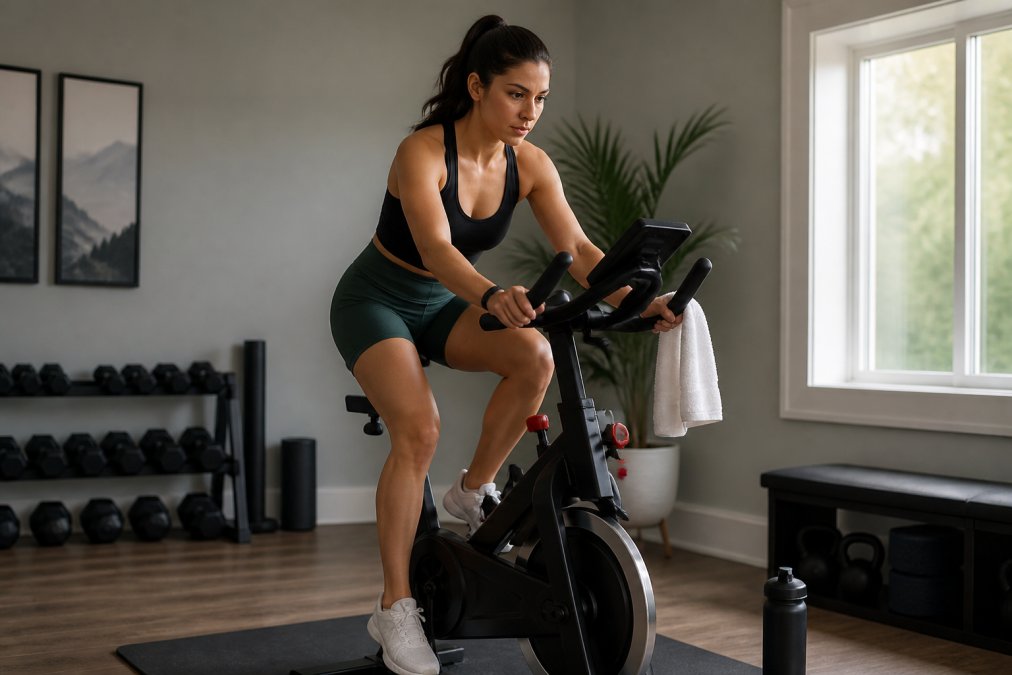
An effective indoor cycling workout routine needs only three ingredients: a warm-up, a main set, and a cool-down. What separates a routine that works from one that just makes you tired is controlling three variables: cadence (revolutions per minute), resistance, and perceived effort. The structure below works on any bike, from a budget upright to a premium spin model, and it scales by adjusting resistance and cadence rather than adding time.
The Three Variables You Actually Control
- Cadence: Aim for 80-90 RPM during steady work, 60-75 RPM during climbs, and 100-110 RPM during short speed efforts. A basic bike computer or a phone cadence app is enough to track this.
- Resistance: Use a scale of 1-10, where 1 is nearly free-spinning and 10 is a grind you can't hold for more than a minute. Most steady riding lives at 4-6.
- Effort (RPE): Rate perceived exertion on a 1-10 scale. Steady blocks should feel like a 5-6, you can speak in short sentences but not hold a full conversation. Intervals push to 8-9.
If you have a heart-rate monitor, a common pattern is to keep steady work at roughly 65-75% of estimated max heart rate and intervals at 80-90%. A rough max-heart-rate estimate is 220 minus your age; treat it as a starting point, not a precise number.
The 30-Minute Session, Step by Step
- Warm-up (5 minutes): Easy resistance (2-3), cadence 80-90 RPM, building gradually. Let your breathing and heart rate rise before any hard work.
- Steady block (10 minutes): Moderate resistance (4-6), cadence 80-90 RPM. This is the aerobic foundation of the session.
- Intervals (4 rounds): 1 minute hard (resistance 7-8, cadence 90-100 RPM), then 2 minutes easy recovery (resistance 2-3, cadence 80 RPM).
- Climb (5 minutes): High resistance (7-9), slow cadence (60-70 RPM), stay seated and keep your upper body relaxed.
- Cool-down (5 minutes): Light resistance, cadence 70-80 RPM, letting heart rate drop gradually.
Beginners should run the steady block only and skip intervals until week three. Advanced riders can double the interval rounds and add a second climb. Adjust resistance, not duration, when a session feels too easy.
How to Progress Without Burning Out
A common pattern is three to four rides per week with at least one easy day between hard sessions. Increase weekly volume by no more than about 10%, if you rode 90 minutes last week, aim for roughly 100 this week, not 150. Progress one variable at a time: add resistance before you add cadence, and add cadence before you add time.
A Simple Weekly Template
- Day 1: Steady 30-minute ride (aerobic base).
- Day 2: Interval session (the 30-minute structure above).
- Day 3: Easy 20-minute recovery spin at resistance 2-3.
- Day 4: Climb-focused ride, 30 minutes with two 5-minute climbs.
Rest or cross-train on the remaining days. The goal is consistency across weeks, not a single heroic session.
Exercise Bike Maintenance Tips for Years of Quiet Operation
Exercise bike maintenance tips that actually matter fall into two buckets: keeping the hardware running quietly, and keeping your body running pain-free. Most guides cover only the first. The second is where riders quit, not because the bike broke, but because their knees or lower back started hurting. Ten minutes a month on the machine and five minutes on setup prevents both problems.
Monthly Hardware Checklist
- Wipe the frame and console after sweaty sessions. Salt and moisture are the leading cause of console corrosion and sticky buttons.
- Check pedal, seat, and handlebar bolts monthly. Vibration loosens them over time, and a wobbly seat is both annoying and a setup hazard. A basic hex key set covers most models.
- Vacuum dust from vents and the flywheel housing. Dust is the most common cause of bearing noise on magnetic and belt-drive bikes.
- Follow the manual's lubrication schedule for chain-drive models. Belt-drive bikes generally need no lubrication at all, which is one reason they're popular in apartments.
- Re-level the bike on uneven floors. A rocking bike stresses the frame and throws off your pedal stroke. Most bikes have adjustable feet or a leveling knob.
- Inspect pedals and straps for wear every few months. Cracked straps or loose clips are a fall risk during hard efforts.
The 12-Month Service Check
After a year of regular riding, a few parts wear faster than the rest. A common pattern is to inspect the following:
- Drive belt or chain tension, a loose belt slips under hard resistance; a loose chain skips.
- Pedal bearings, listen for grinding or clicking under load.
- Seat post and adjustment knobs, worn knobs let the seat slip mid-ride.
- Console battery or power adapter, replace before it dies mid-session.
Ergonomic Setup and Injury Prevention
Injury prevention starts with setup, not effort. This is the part most buying guides skip, and it's the reason so many home bikes end up unused.
Warm-Up and Recovery Habits That Protect Your Joints
A five-minute easy spin before any hard effort lets your joints and muscles adapt to the load. Skipping it is the most common cause of tweaks during interval work. After a ride, a few minutes of easy pedaling and light stretching for the quads, hamstrings, and calves keeps range of motion from tightening up over weeks of training.
Frequently Asked Questions
What type of bike is best for exercise?
It depends on your body and goals. An upright bike for workout sessions mimics road cycling and recruits more core and upper-body stabilizers. A recumbent bike supports your lower back and suits longer, lower-intensity rides. Air bikes add full-body arm work but are louder. For most home gyms, a magnetic upright or recumbent with adjustable seat height and 8 or more resistance levels covers the widest range of workouts.
Can you lose belly fat by riding a stationary bike?
You cannot target belly fat with any single machine. Spot reduction does not work. What a stationary bike does well is burn calories through sustained cardio training and interval training, which creates the calorie deficit that drives overall fat loss. Pair 3 to 5 weekly rides of 30 to 45 minutes with strength training and a consistent diet, and fat loss across your whole body, including the midsection, becomes achievable.
Is 30 minutes of biking a day enough exercise?
For general health, 30 minutes of moderate indoor cycling five days a week meets common physical activity guidelines. For weight loss or aerobic capacity gains, add two or three higher-intensity interval sessions per week. A practical indoor cycling workout routine: warm up 5 minutes, ride 20 minutes at a challenging but sustainable pace, then cool down 5 minutes.
How much space do I need for a home workout bike?
Most upright and recumbent bikes need a footprint of roughly 4 by 2 feet, plus 2 feet of clearance behind and on each side for mounting and pedaling. Folding frame models collapse to about half that depth for storage. Measure your ceiling height too if you plan to stand on the pedals. A quiet belt drive model lets you ride in an apartment without disturbing neighbors.
Choosing the right bike for workout use is really a decision about consistency: hardware that fits your body, resists noise, and doesn't lock your data behind a monthly fee. At Body Fuel Fury, we stock durable home gym equipment with the value-driven pricing and customer-first service that make building a home setup straightforward. Browse our fast, user-friendly online store, compare options, and get the gear that keeps you riding. Shop Now and build a home workout space that lasts.