
 ultimate-guide
Best Access to High-Quality Fitness Goods for Durable Equipment
Table of Contents
- What Makes Fitness Equipment Actually Durable?
- Where to Find the Best Home Gym Equipment Brands
- Essential Home Gym Setup Checklist: What You Actually Need
- How to Maintain Home Gym Equipment for Long-Term Performance
- Lifecycle Cost Analysis: Why Cheap Equipment Costs More
- Space-Efficiency and Assembly Logistics for Small Homes
- Conclusion: Making a Smart Investment in Durable Fitness Equipment
- Frequently Asked Questions
Last Updated: September 14, 2026
What Makes Fitness Equipment Actually Durable?
Durable fitness equipment is gear built to survive years of repeated loading without losing structural integrity, and the difference shows up in three places: steel gauge, weld quality, and finish.
The best access to high-quality fitness goods for durable fitness equipment starts with knowing what to inspect before you buy. Most buyers compare price tags. Smart buyers compare load ratings, steel thickness, and warranty terms.
Here's the uncomfortable truth: two power racks can look identical in photos and differ by hundreds of pounds of real-world capacity. The specs tell you which one will still be standing in ten years.
Build Quality Signals: Steel Gauge, Welds, and Finish
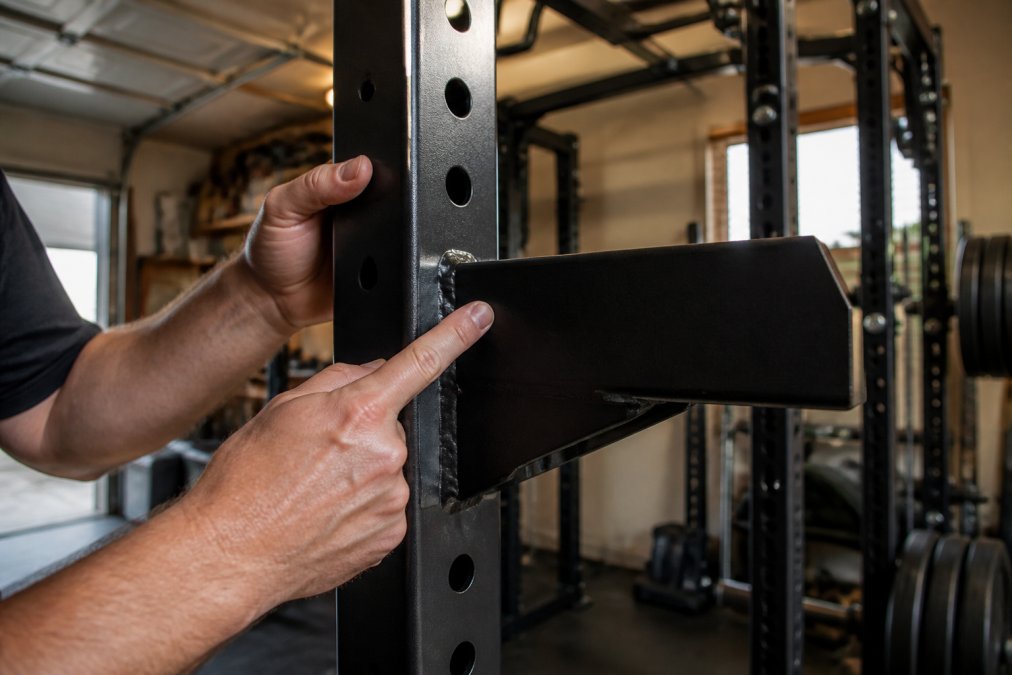
Steel gauge determines how much load a frame handles before it deforms. Lower gauge numbers mean thicker steel, and commercial-grade racks typically run 11- to 12-gauge tubing (Steel Standards - Standards Products - Standards & Publications). Anything above 14-gauge deserves scrutiny for heavy strength work.
Welds matter just as much. Clean, consistent beads at every joint signal controlled manufacturing. A powder-coated finish resists chipping and rust, which matters in garages and basements where humidity swings.
Weight Capacity, Warranty Coverage, and Safety Certifications
Weight capacity ratings tell you what the manufacturer will stand behind. A rack rated for 1,000 pounds gives you headroom for a 300-pound lifter plus heavy barbell work.
Warranty coverage is the other half of that equation. Frame warranties of ten years or more signal confidence in structural integrity. One-year frame warranties usually mean the opposite.
Safety certifications add a third layer. Look for equipment tested against recognized standards for load-bearing and structural integrity, which matters most for racks, benches, and cable systems.
Where to Find the Best Home Gym Equipment Brands
The best home gym equipment brands fall into three categories, and each serves a different buyer. Specialty manufacturers build for longevity. Big-box retailers sell convenience. Online marketplaces offer selection and price variety.
Specialty manufacturers like Rogue Fitness focus on heavy-duty steel construction and modular design. Their equipment holds resale value well because the build quality is verifiable. The trade-off is premium pricing.
Retailers such as DICK'S Sporting Goods let you see equipment in person before buying. That matters if you want to test ergonomics and footprint before committing. Inventory varies by location, so call ahead.
Online marketplaces like Amazon offer unmatched selection and fast shipping, but quality varies widely across third-party sellers. Read the reviews that mention long-term durability, not the ones written the day the box arrived.
Body Fuel Fury is a curated online retailer with years of industry experience, a user-friendly interface, and a customer-service-oriented approach. For shoppers who want value-driven pricing without gambling on unknown sellers, that combination is hard to beat.
| Source Type | Best For | Watch Out For |
|---|---|---|
| Specialty manufacturers | Serious strength athletes | Higher upfront cost |
| Big-box retailers | Seeing gear in person | Limited inventory |
| Online marketplaces | Selection and speed | Variable seller quality |
| Curated online retailers | Value and support | Fewer showroom visits |
Essential Home Gym Setup Checklist: What You Actually Need
A functional home gym needs six things, and buying them in the right order saves money. Skip the extras until the foundation is solid.
- Rack or squat stand with a load rating above your heaviest projected lift
- Barbell and plates in a weight range you'll actually use for years
- Adjustable bench rated for flat, incline, and decline work
- Flooring that protects both your subfloor and your equipment
- Storage for plates, bands, and accessories to keep the footprint clear
- Cardio option matched to your training goals, not the latest trend
That last point matters more than most guides admit. A rower and a treadmill serve completely different purposes. Buy for the training you'll sustain, not the training you imagine.
How to Maintain Home Gym Equipment for Long-Term Performance
Preventative maintenance is what separates equipment that lasts a decade from equipment that lasts three years. The routine is simple, and most of it takes minutes per month.
Wipe down frames and upholstery after sessions to prevent sweat damage. Check bolts and fasteners monthly, since vibration loosens connections over time. Lubricate cable-driven systems and guide rods according to the manufacturer's schedule.
Preventative Maintenance Schedule and Repairability
| Task | Frequency | Why It Matters |
|---|---|---|
| Wipe frames and pads | After each session | Prevents corrosion and cracking |
| Tighten bolts and fasteners | Monthly | Maintains structural integrity |
| Lubricate cables and rods | Quarterly | Keeps movement smooth |
| Inspect welds and joints | Every 6 months | Catches fatigue early |
| Replace worn cables | As needed | Prevents sudden failure |
Repairability deserves equal attention. Equipment with replaceable cables, bearings, and pads outlives sealed units that require full replacement when one part fails. Before buying, check whether the manufacturer sells individual replacement parts.
Lifecycle Cost Analysis: Why Cheap Equipment Costs More
Most buying guides stop at the sticker price. That is the wrong number. For durable goods, the number that matters is cost per use, total ownership cost divided by the number of sessions the equipment actually survives. This is the angle almost no competitor covers, and it is the one that changes what you should buy.
The formula is simple:
Cost per use = (Purchase price + Maintenance + Repairs + Replacement − Resale value) ÷ Total sessions
Run it on two racks. A budget rack at a low upfront price that flexes under heavy loading may need replacing in two to three years. A commercial-grade rack at roughly three to four times the price, with a ten-year-plus frame warranty and replaceable parts, can plausibly serve fifteen years. Spread across four sessions a week, the durable rack's cost per use typically lands below the budget rack's, often well below once you count the second and third budget purchases.
The Four Cost Buckets Buyers Forget
1. Replacement frequency. Cheap equipment fails on a cycle. If a budget bench lasts three years and a commercial bench lasts fifteen, you buy the budget bench five times to match one durable unit. The sticker price is not the comparison; the five-purchase total is.
2. Repair and parts availability. Equipment with replaceable cables, bearings, bushings, and pads can be serviced indefinitely. Sealed units that require full replacement when one component fails have a hard ceiling on lifespan regardless of how good the frame is. Before buying, confirm the manufacturer sells individual replacement parts, not just full assemblies.
3. Resale value. Durable, verifiable equipment holds resale value in a way budget gear does not. A well-built rack from a known specialty manufacturer commonly resells for a meaningful fraction of its original price years later, which offsets the upfront premium. Budget racks from unknown sellers typically resell for close to nothing because buyers cannot verify the build.
4. Safety and downtime. A structural failure mid-lift is not just a repair bill, it is an injury risk and weeks of lost training. That cost never appears on a price tag, but it belongs in the analysis.
A Worked Comparison
Say you train four times a week, about 200 sessions a year.
- Budget rack: lower upfront price, replaced every three years, minimal resale. Over fifteen years that is five purchases plus disposal, with no parts support.
- Durable rack: higher upfront price, one purchase, occasional cable or pad replacement, meaningful resale at the end.
Divide each total by 3,000 sessions (200 × 15) and the durable rack's cost per use is frequently the lower number, and it is the only one still standing in year fifteen.
The cheapest equipment is the equipment you buy once. Compare cost per use over a ten-to-fifteen-year horizon, not the price on the product page. A durable rack that lasts fifteen years usually costs less per session than three budget racks that each last five.
Space-Efficiency and Assembly Logistics for Small Homes
Most guides assume a garage gym. If you are working with a spare bedroom, a living-room corner, or a rental apartment, the constraints are different, and so is the equipment that actually works. This is an underserved niche, and it is where space planning and assembly logistics decide whether the purchase succeeds.
Space-Efficiency Mechanisms That Actually Save Room
Folding and wall-mounted racks. A folding wall-mount rack swings flat against the wall between sessions, reclaiming the floor for daily life. The trade-off is installation: it must be anchored into structural framing or a properly engineered mounting surface, not drywall alone. Confirm the wall type before ordering.
Modular and multi-function stations. A single upright-and-crossmember system that supports a rack, a cable attachment, and a pull-up bar replaces three separate machines. Modularity also means you can expand later without replacing the base.
Adjustable dumbbells and plate-loaded options. Adjustable dumbbells replace an entire rack of fixed pairs in a fraction of the footprint. Plate-loaded cable systems use your existing plates instead of a built-in weight stack, cutting both cost and floor area.
Vertical storage. Plate trees, wall-mounted bar holders, and band pegs move storage off the floor. In small rooms, vertical storage is often the difference between a usable training area and a cluttered one.
Measure These Before You Buy
Two measurements prevent most delivery-day and setup disasters:
- Ceiling height. Anything overhead, pull-up bars, rack uprights, cable crossovers, needs clearance above your tallest reach. Measure at the lowest point of the ceiling, not the average.
- Doorways and stairwells. Assembled equipment frequently will not fit through a standard interior opening. Measure the narrowest path from the delivery point to the training space, including turns.
Add a third: floor type. Concrete, wood subfloor, and upper-floor apartments each change what anchoring and flooring you need. Dropped plates crack concrete and destroy thin rubber mats; a proper platform or dense rubber tile protects both the subfloor and the equipment.
Assembly and Installation Logistics
High-quality equipment is heavy, and heavy equipment arrives in crates. Plan for it.
- Staging area. You need a clear space larger than the assembled footprint to unpack and sort hardware before assembly begins.
- Two people minimum. Rack uprights and benches are awkward and heavy; most assemblies are not a one-person job.
- Time budget. A rack and bench assembly commonly takes the better part of a weekend for a first-timer. Cable systems and multi-stations take longer.
- Professional installation. Many specialty manufacturers and some retailers offer installation support or partner with local installers. For wall-mounted and ceiling-anchored equipment, professional installation is often worth the cost, it protects your wall, your equipment, and your warranty.
Skipping proper flooring and anchoring is the most common small-space home gym mistake. Dropped plates crack concrete and damage thin rubber mats within months, and wall-mounted racks anchored into drywall can pull free under load. The repair cost, and the safety risk, usually exceeds what proper flooring and installation would have cost upfront.
For renters and apartment dwellers, space-saving designs like folding wall-mount racks and adjustable dumbbells protect both your training and your security deposit, but only if the anchoring and flooring are done correctly.
Conclusion: Making a Smart Investment in Durable Fitness Equipment
The challenge is separating genuine durability from marketing claims, and that takes knowing which specs actually matter. Steel gauge, weld quality, warranty coverage, and repairability tell you more than any product photo.
Body Fuel Fury makes that evaluation easier with a fast online shopping experience, a user-friendly interface, and a customer service-oriented approach backed by years of industry experience. Every product comes with value-driven pricing and real support when something doesn't fit your space or goals.
Shop now with Body Fuel Fury and build a home gym that outlasts every trend.
Frequently Asked Questions
How do I determine if fitness equipment is durable?
Check the steel gauge, weld quality, and weight capacity. Look for heavy-duty steel construction, a powder-coated finish to resist rust, and safety certifications. A generous warranty coverage period is a strong signal that the manufacturer stands behind its build quality.
Where is the best place to buy fitness equipment online?
Specialty fitness retailers offer commercial-grade gear with better warranty support than general marketplaces. Body Fuel Fury provides access to high-quality fitness goods with a user-friendly interface and customer-service-oriented approach. For durable fitness equipment, prioritize retailers that publish detailed specifications, offer clear return policies, and provide responsive support when something arrives damaged or does not fit your space.
What should I look for when buying home gym equipment?
Start with your training goals and available footprint. Prioritize multi-functional pieces with adjustable resistance and biomechanical alignment. Verify weight capacity, warranty coverage, and whether replacement parts are available. For a complete home gym setup checklist, include a barbell, plates, adjustable bench, rack, and flooring. Buy the highest build quality you can afford for core items like racks and bars.
How do I maintain home gym equipment to extend its lifespan?
Wipe down upholstery and grips after every session. Check and tighten bolts monthly, especially on racks and cable-driven systems. Lubricate cables and guide rods according to the manufacturer's schedule. Inspect welds and powder-coated finish for chips that could lead to rust. Keep equipment in a climate-controlled space when possible, and address small repairs immediately before they become structural issues.