 ultimate-guide
Exercise & Fitness Equipment: 2026 Buying Guide
Table of Contents
- How to Choose Fitness Equipment That Matches Your Goals
- Cardio Equipment: From Treadmills to Rowing Machines
- Essential Strength Training Equipment for Every Level
- Best Home Gym Equipment for Small Spaces
- Fitness Equipment and App Integration
- How to Maintain Gym Equipment to Protect Your Investment
- Recovery and Rehab Tools Worth Adding to Your Setup
- Frequently Asked Questions
Last Updated: August 25, 2026
Choosing the right exercise & fitness equipment is harder than it looks. This guide from Body Fuel Fury cuts through market noise with a practical, goal-first framework for building a setup that actually works, whether you're outfitting a spare bedroom or upgrading a full home gym.
Fitness equipment is any tool or machine designed to support structured physical training, from simple resistance bands to motorized treadmills. The right choice depends on your goals, space, budget, and fitness level, not on what's trending.
How to Choose Fitness Equipment That Matches Your Goals
Start with your goal, not the equipment. Are you training for cardiovascular health, muscle hypertrophy, functional fitness, or some combination? Each goal points to a different equipment category. Aerobic capacity improvements come from sustained cardio work. Progressive overload for muscle growth requires adjustable resistance. Functional fitness often needs very little equipment at all.
| Fitness Goal | Primary Equipment | Secondary Equipment |
|---|---|---|
| Cardiovascular health | Treadmill, elliptical trainer, rowing machine | Jump rope, stationary cycling bike |
| Muscle hypertrophy | Barbell, weight plates, adjustable dumbbells | Cable machine, resistance bands |
| Functional fitness | Kettlebell, pull-up bar | Resistance bands, gymnastic rings |
| Low-impact workout | Elliptical trainer, rowing machine | Resistance bands, stationary bike |
| Recovery and rehab | Foam roller, massage gun | Resistance bands, balance board |
Beginner vs. Advanced: What Changes and What Doesn't
Beginners often buy advanced equipment before mastering foundational movement patterns. A barbell is fantastic but risky without proper hip hinge or squat technique. Prioritize movement quality over load: adjustable dumbbells, resistance bands, and a pull-up bar cover foundational movements without large investment or floor space.
Advanced trainees need equipment supporting progressive overload over months and years. Durable construction and weight capacity matter more at this stage due to higher loads and greater frequency of use.
What doesn't change: the importance of good gym flooring, proper setup, and ergonomic design that keeps joints safe.
Injury Prevention and Ergonomic Considerations
Most home gym injuries stem from poor setup, not defective equipment. According to the American College of Sports Medicine's exercise safety resources, proper biomechanics and equipment fit are primary injury prevention factors.
Ergonomic design matters most for seated and supported movements. A bench with inadequate back support, a bike saddle at the wrong height, or a poorly designed rowing machine footrest can create repetitive stress over time. Check whether equipment is adjustable for your height and body proportions before buying.
Gym flooring is essential. Rubber flooring protects joints during high-impact movements, protects your floor from dropped weights, and reduces equipment vibration.
Cardio Equipment: From Treadmills to Rowing Machines
Cardio equipment is the largest home gym category and where the most money gets wasted on wrong purchases.
Treadmills remain popular for aerobic training. Incline functionality separates useful machines from basic ones. Incline walking and running engage more muscle groups and increase caloric output significantly. Prioritize motor power, belt size, and incline range over built-in screens.
Rowing machines deliver full-body conditioning unmatched by other single cardio machines. A rowing stroke engages legs, core, and upper body sequentially, making it efficient for cardiovascular health and muscular endurance. Rowing machines are gentler on joints than treadmills, suiting anyone managing knee or hip issues.
Elliptical trainers offer low-impact workouts approximating running mechanics without joint stress. They suit people returning from injury or wanting sustained cardio without high-impact loading.
Stationary cycling, upright or recumbent, is another low-impact option with strong cardiovascular health data. High-intensity interval training on a stationary bike is one of the most time-efficient cardio protocols available.
Essential Strength Training Equipment for Every Level
Essential strength training equipment doesn't require a rack of machines or commercial gym layout. The most effective setups are often the simplest.
Free Weights, Barbells, and Weight Plates
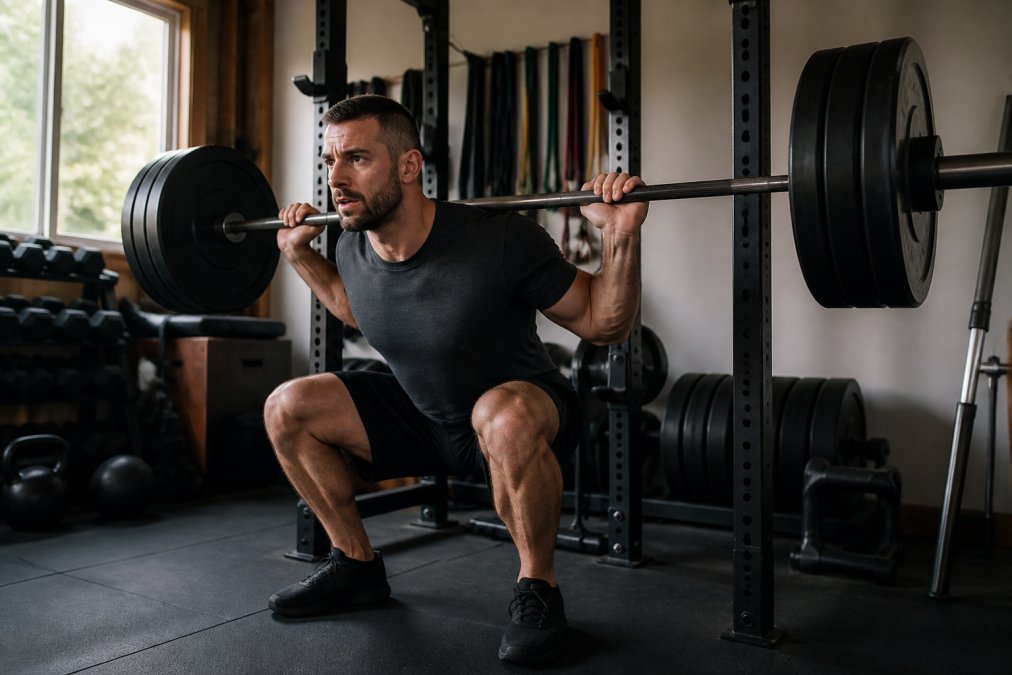
Barbells and weight plates form the foundation of serious strength training. A standard 45 lb barbell with weight plates gives access to the squat, deadlift, bench press, and overhead press, movements driving the most muscle hypertrophy and overall strength development.
Adjustable dumbbells are smarter for most home gyms with limited floor space. A quality pair replaces an entire rack of fixed dumbbells and allows incremental load increases that progressive overload requires. Durable construction is key; cheap adjustable dumbbells have selector mechanisms that fail under regular use.
Kettlebell training occupies a useful middle ground between free weights and functional fitness tools. A single kettlebell supports swings, Turkish get-ups, goblet squats, and carries, movements developing core stability, hip power, and grip strength simultaneously.
Resistance Bands and Bodyweight Tools
Resistance bands are the most underrated fitness equipment category. A full set covers everything from warm-up activation to heavy assistance for compound movements. They're also the most space-efficient option available.
Calisthenics and bodyweight training have surged, and supporting equipment is minimal. A pull-up bar, gymnastic rings, and parallettes cover most advanced bodyweight work. Training stimulus from bodyweight movements, applied with sufficient intensity and volume, is comparable to free weight training for most fitness goals.
According to the National Strength and Conditioning Association, resistance band training produces meaningful strength and hypertrophy adaptations when programmed with appropriate volume and progressive overload, making bands a legitimate primary training tool.
Best Home Gym Equipment for Small Spaces
Space-saving equipment has improved dramatically. The best home gym equipment for small spaces no longer means compromising training quality.
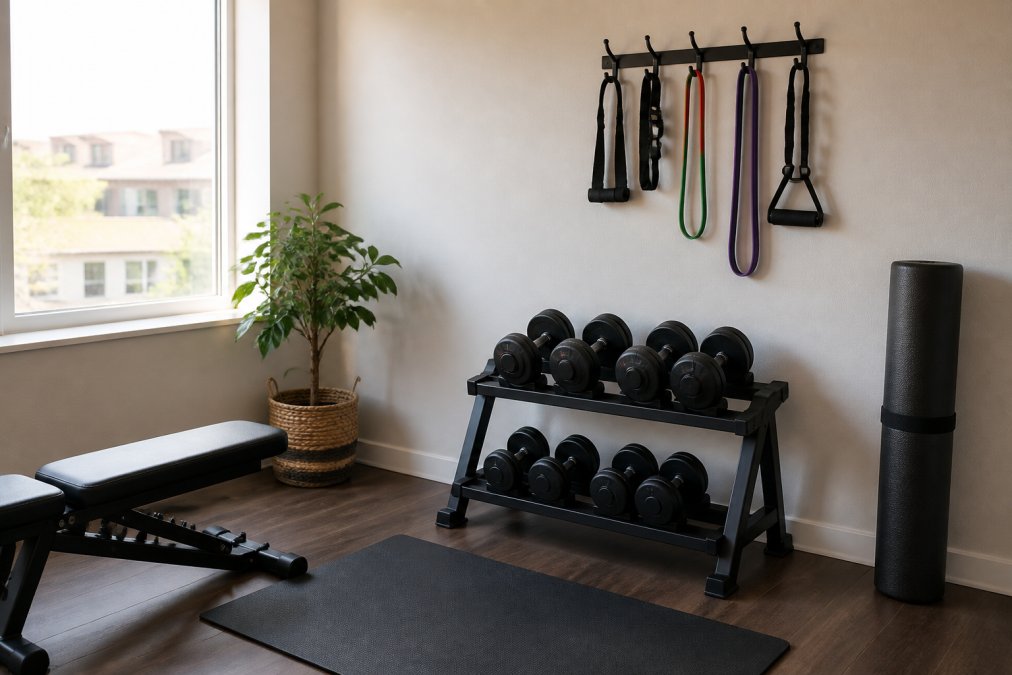
The most space-efficient full-body setup combines adjustable dumbbells, resistance bands, a doorframe pull-up bar, and a foldable exercise mat. This covers strength training, cardiovascular conditioning through circuits, and mobility work without requiring dedicated floor space when not in use.
Wall-mounted storage is the single best investment for small home gyms. Keeping equipment off the floor reduces setup friction, directly affecting training consistency. A setup requiring assembly before every session gets skipped.
Foldable benches, wall-mounted pull-up rigs, and compact rowing machines with vertical storage exist specifically for this use case. Floor space requirements should be a primary specification before purchasing large equipment.
Fitness Equipment and App Integration
Fitness tracking has changed home training. Most modern cardio equipment includes Bluetooth connectivity and compatibility with popular fitness apps, genuinely improving outcomes by making progress visible and measurable.
Treadmills, stationary bikes, and rowing machines with open API connectivity sync heart rate data, workout duration, and power output directly with apps like Apple Health, Google Fit, and third-party training platforms. This matters because fitness goals require consistent progressive overload, and tracking data is the only reliable way to know whether you're progressing.
Smart resistance tools, including connected adjustable dumbbells and resistance bands with tension sensors, bring data visibility to strength training. These are particularly useful for beginners lacking body awareness to gauge effort accurately.
The value isn't in the data itself but in behavior change from seeing training history. People who track workouts consistently train more consistently.
As documented in the CDC's physical activity guidelines for Americans, adults benefit most from combining aerobic and muscle-strengthening activities each week. Connected equipment tracking both types gives a complete picture of whether your home routine meets those guidelines.
How to Maintain Gym Equipment to Protect Your Investment
Knowing how to maintain gym equipment separates a setup lasting a decade from one deteriorating in two years. This section is often skipped but costs the most money long-term.
Most important maintenance tasks by equipment type:
- Treadmills: Lubricate the belt every three to six months. Check belt tension monthly. Clean the motor compartment annually.
- Barbells and weight plates: Wipe down after every session. Apply light oil to bare steel barbells monthly to prevent rust. Inspect collars regularly.
- Adjustable dumbbells: Keep the selector mechanism clean and dry. Never drop them; internal selector pins are the failure point.
- Resistance bands: Inspect for micro-tears before every session. Store away from direct sunlight and extreme heat.
- Rowing machines: Clean the rail and seat rollers weekly. Check the chain or strap for wear every few months.
Long-term durability and maintenance costs are rarely discussed but affect total cost of ownership. Cheaper equipment requiring replacement parts after 18 months often costs more than durable options purchased at higher upfront prices.
For gym flooring, sweep regularly and clean with pH-neutral cleaner. Avoid harsh chemicals that degrade rubber compounds.
Recovery and Rehab Tools Worth Adding to Your Setup
Recovery tools are often treated as optional extras. They're not. Adequate recovery allows training stimulus to translate into actual adaptation.
The core recovery toolkit includes:
- Foam roller: Addresses myofascial restriction and improves tissue quality. Use before and after training sessions.
- Massage gun: More targeted than foam rollers for specific muscle groups. Useful for post-training soreness and pre-training activation.
- Resistance bands for mobility work: Bands provide joint distraction improving range of motion more effectively than static stretching.
- Ice and heat therapy tools: Reusable ice packs and heating pads remain the most evidence-supported recovery interventions for acute soreness and chronic tightness.
For people managing existing injuries or returning from surgery, rehab-specific equipment like balance boards and light resistance tools support gradual rebuilding of joint stability and proprioception. As outlined in the National Institutes of Health's exercise and rehabilitation research, progressive loading with appropriate recovery periods is the evidence-based approach for both injury prevention and rehabilitation.
Body Fuel Fury carries recovery tools alongside its full range of fitness equipment, making it straightforward to build a complete setup from a single source.
| Recovery Tool | Best For | Frequency of Use |
|---|---|---|
| Foam roller | General muscle soreness, mobility | Daily |
| Massage gun | Targeted muscle groups, acute soreness | Post-training |
| Resistance bands | Joint mobility, rehab activation | Daily |
| Ice pack | Acute inflammation, post-training | As needed |
| Heating pad | Chronic tightness, pre-training | Pre-training |
A common mistake is buying recovery tools and using them only when something hurts. Build a brief recovery protocol into every training session. Ten minutes of foam rolling and mobility work after each session accumulates into significant injury risk reduction over months of training.
Building a home gym that actually works requires matching equipment to goals, choosing durable construction over flashy features, and treating recovery as part of training rather than an afterthought. Body Fuel Fury offers a full range of exercise & fitness equipment, from essential strength training gear to cardio machines and recovery tools, all backed by customer service and value-driven pricing. Browse the current selection and find the gear that fits your space, goals, and budget.
Frequently Asked Questions
What equipment is essential for a beginner home gym?
A beginner home gym works well with a few versatile pieces: a set of adjustable dumbbells, a resistance band set, a sturdy exercise mat, and a pull-up bar. These cover strength training, core stability, and low-impact cardio without requiring much floor space or a large upfront investment. As your fitness goals become clearer, you can add a kettlebell or a compact cardio machine. Starting simple keeps costs manageable and prevents the common mistake of buying gear you won't use.
What is the best affordable home workout equipment?
Resistance bands, adjustable dumbbells, and kettlebells consistently offer the most workout versatility per dollar. Resistance bands support progressive overload, full-body conditioning, and rehabilitation exercises. Adjustable dumbbells replace an entire rack of fixed weights in a fraction of the floor space. For cardio, a jump rope delivers a high-intensity interval training workout at minimal cost. Pricing varies by brand and quality tier, so visit Body Fuel Fury's site for current options that fit your budget.
What is the best exercise equipment for seniors?
Seniors benefit most from low-impact equipment that protects joints while maintaining cardiovascular health and muscle mass. Recumbent bikes, elliptical trainers, and resistance bands are widely recommended because they reduce joint stress compared to treadmill running. Light adjustable dumbbells support muscle hypertrophy and bone density without excessive load. Ergonomic design and clear weight capacity ratings matter more for this group than raw performance specs. Always consult a physician before starting a new exercise program.
How do I maintain gym equipment to make it last longer?
Wipe down all surfaces after each session using a mild cleaner safe for the material. Lubricate treadmill belts and cable pulleys every three to six months, or per the manufacturer's schedule. Check bolts and fasteners monthly since vibration loosens them over time. Store free weights on proper racks to prevent floor damage and warping. Keep equipment away from humidity where possible, as moisture accelerates rust on weight plates and cable components. Consistent upkeep significantly reduces long-term repair and replacement costs.