
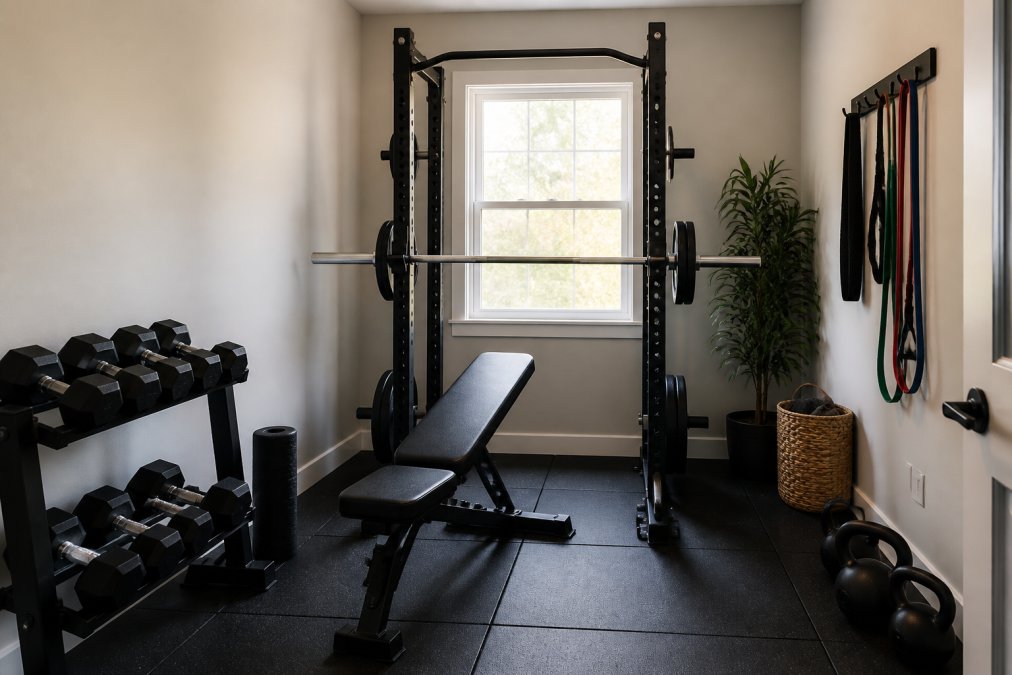
 ultimate-guide
How to Set Up a Home Gym in a Small Space: 2026 Guide
Table of Contents
- What You'll Need Before You Start
- Measure and Plan Your Home Gym Layout
- Best Space-Saving Gym Equipment for Compact Rooms
- Home Gym Storage Ideas for Small Rooms
- Budget-Friendly Home Gym Setup Tips
- Rental-Friendly Modifications and Acoustic Dampening
- Maintenance and Psychological Zoning for Your Home Gym
- Frequently Asked Questions
Last Updated: September 16, 2026
What You'll Need Before You Start
Learning how to set up a home gym in a small space starts with an honest inventory, not a shopping spree. Before you buy a single piece of equipment, measure your available square footage, note your ceiling height, and decide which exercises you actually perform each week.
This guide from Body Fuel Fury walks through how to set up a home gym in a small space without turning your living room into a warehouse.
Most people overbuy in month one and quit by month three.
- Tape measure and notebook (record length, width, ceiling height)
- A list of your 5-8 most-used exercises
- A budget ceiling for the first 90 days
- One storage zone identified before any purchase
- A flooring decision (mat, tiles, or nothing)
Measure and Plan Your Home Gym Layout
The best home gym layout starts with a floor plan drawn to scale on paper or in a free room-planning app. Mark doors, windows, radiators, and any furniture that cannot move.
Flooring and Protective Mats
Floor protection is the cheapest insurance you can buy for a small gym. Rubber mats absorb dropped weights, protect hardwood and tile, and reduce the thud that travels to the floor below.
Safety Clearance and Ergonomics
Safety clearance is the empty space around a piece of equipment that lets you move, fall, or bail out without hitting anything. For a foldable weight bench or squat rack, plan for at least 60 centimeters on every side and more behind you for a barbell.
Best Space-Saving Gym Equipment for Compact Rooms
The best space-saving gym equipment solves one problem each, stores flat, and earns its footprint. The mistake most people make is buying by category ("I need dumbbells") instead of by movement pattern ("I need to press, pull, hinge, and squat"). Buy one tool per pattern, and you can cover a full week of training in under 15 square feet of stored gear.
| Equipment | Footprint When Stored | Movement Patterns Covered | Setup Time | Watch Out For |
|---|---|---|---|---|
| Adjustable dumbbells | Small shelf or bin | Press, row, hinge, carry | 5-15 sec per change | Slow dial mechanisms; check max load |
| Resistance bands | Drawer or pegboard | Pull, mobility, warm-ups | Instant | Limited max load; degrade in sunlight |
| Foldable weight bench | Against a wall | Pressing, rows, step-ups | 10-20 sec | Hinge wear; less stable than fixed |
| Kettlebells | Floor corner | Swing, carry, squat | Instant | Needs 3+ ft swing clearance |
| Suspension trainer | Door frame or hook | Bodyweight pull, push, core | 30-60 sec | Door must be solid and swing inward |
| Pull-up bar (doorframe) | Stays mounted | Vertical pull | Instant | Doorframe trim must support load |
How to Choose Between Overlapping Options
Three decisions cover most small-space buyers:
Adjustable dumbbells vs. kettlebells. Adjustable dumbbells win if you want to press and row with incremental loading. Kettlebells win if your routine is swing- and carry-heavy and you have the clearance to use them. If you can only buy one, adjustable dumbbells cover more exercises per square foot.
The Equipment That Isn't Worth the Footprint
A few categories look compact on a product page but fail in a small room:
- Full barbell sets. A 7-foot barbell plus plates needs roughly 8 feet of wall and a safety zone behind you. Unless you have that clearance, a barbell becomes a coat rack.
- Budget cable machines. They replace several tools on paper, but entry-level models have a narrow resistance range and a large footprint. Try one in person before committing.
- Fixed-weight dumbbell racks. A 5-50 lb rack eats a wall and locks you into one load per hand. Adjustable dumbbells do the same job in a bin.
A Minimum Viable Kit for Under 15 Square Feet
If you are starting from zero and space is tight, this kit covers a full-body program:
- Adjustable dumbbells (one pair)
- Resistance band set (five bands, one door anchor)
- Foldable bench
- Interlocking rubber tiles for the lifting zone
- One storage bin or wall rack
Multi-Functional and Foldable Gear
Multi-functional gear earns its place by doing two jobs. A pull-up bar that also anchors a suspension trainer covers vertical pulling and bodyweight exercises from one mount. A bench with a built-in band peg covers pressing and band-resisted work without a second tool.
Home Gym Storage Ideas for Small Rooms
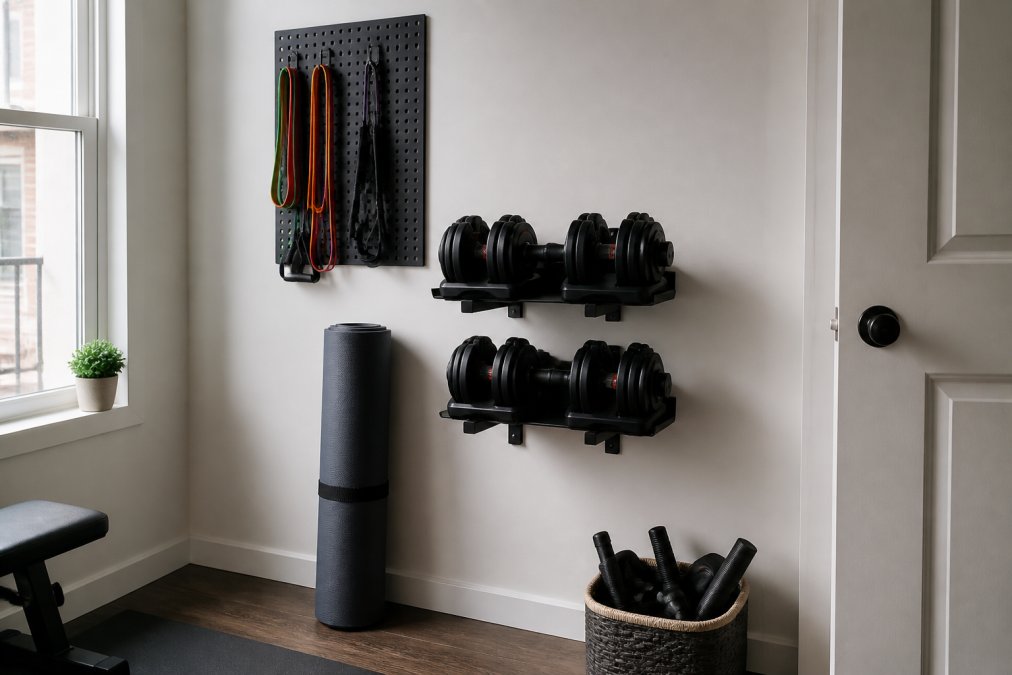
Home gym storage ideas for small rooms work best when they go vertical and stay non-permanent. Most guides tell you to drill a wall rack and call it done, which is useless if you rent, if your walls are plaster, or if you might move the gym to another room next year. The systems below hold a full compact gym without a single anchor hole.
Non-Permanent Storage Systems That Actually Hold Weight
The constraint with rental-friendly storage is load. A tension rod holds a yoga mat; it will not hold a 50 lb dumbbell. Match the system to the weight:
| System | Holds | Load Limit (typical) | Permanent Damage |
|---|---|---|---|
| Over-the-door hooks | Bands, straps, mat | Light (under ~10 lb) | None |
| Freestanding shelving unit | Dumbbells, kettlebells, bins | Heavy (100+ lb per shelf) | None |
| Rolling storage cart | Dumbbells, bands, accessories | Heavy | None |
| Tension-mounted vertical rack | Bands, mats, light accessories | Light to medium | None |
| Leaning ladder rack | Mats, bands, straps | Light | None |
| Wall-mounted pegboard | Anything | Heavy | Requires drilling |
Vertical Storage Without Drilling
If you want the look of a wall rack without the holes, three options work:
- Leaning ladder racks rest against the wall and hold mats, bands, and straps. They tip if overloaded, so keep them light.
- Over-the-door organizers (the kind sold for shoes) hold bands, jump ropes, and small accessories. Check your door's top clearance first.
- Freestanding vertical racks with a weighted base hold dumbbells and kettlebells without touching the wall.
The Closet Conversion
A standard reach-in closet is roughly 2 feet deep and 5-6 feet wide, enough for a full compact gym if you strip the hanging rod and add shelves. Keep the door on so you can close the gym away when guests arrive. This is the single highest-leverage storage move in a small apartment, and it requires no landlord permission.
Organization Habits That Keep the Floor Clear
Storage only works if you use it. Two habits do most of the work:
- One-touch rule. When a session ends, every piece of gear goes back to its home before you leave the zone. Gear that sits out overnight becomes furniture.
- Weekly reset. Once a week, empty the bins, wipe them down, and put everything back. This catches the small items that migrate to countertops and coffee tables.
Budget-Friendly Home Gym Setup Tips
A budget-friendly home gym setup follows a simple order: floor protection first, then one adjustable strength tool, then storage, then everything else.
Rental-Friendly Modifications and Acoustic Dampening
Renters face two constraints: no permanent damage, and no angry neighbors. Both are solvable.
Maintenance and Psychological Zoning for Your Home Gym
Gear in a garage or non-climate-controlled space needs attention. Humidity rusts steel, and temperature swings dry out rubber and vinyl. Wipe metal down monthly, keep a moisture absorber in the storage bin, and store bands away from direct sunlight.
Frequently Asked Questions
What is the best home gym setup for a small space?
The best small space home gym uses multi-functional equipment like adjustable dumbbells, a foldable weight bench, and resistance bands. Focus on vertical storage with wall-mounted racks and a pegboard. Prioritize a squat rack or pull-up bar that fits your ceiling height. Keep the floor clear with rubber mats for protection. This setup covers strength, cardio, and mobility without taking over the room.
How much space do you actually need for a home gym?
You can build a functional home gym in as little as 50 to 100 square feet. For a basic setup with dumbbells and a bench, 6 by 6 feet works. If you add a squat rack or cable machine, aim for 8 by 10 feet. Always include safety clearance of at least 2 feet around equipment. Measure your room and plan the layout before buying gear to avoid clutter.
What are the most versatile pieces of equipment for small home gyms?
Adjustable dumbbells, a foldable weight bench, resistance bands, and a suspension trainer are the most versatile. Adjustable dumbbells replace an entire rack of weights. A foldable bench stores upright. Resistance bands and suspension trainers cover many exercises and pack away. A pull-up bar that mounts in a doorway adds upper body work without floor space. These tools support hundreds of exercises.
How can I organize a home gym in a tiny apartment?
Use vertical storage like wall-mounted racks, pegboards, and over-the-door hooks. Choose foldable equipment such as a foldable weight bench or wall-mounted squat rack. Store small items in storage bins under the bed or on shelves. Keep the floor clear by mounting as much as possible. For rentals, use removable adhesive hooks and freestanding shelves that do not damage walls.
Setting up a home gym in a small space is a planning problem before it is a shopping problem. Get the layout, clearance, and storage right, and the equipment almost chooses itself. Body Fuel Fury stocks durable gym equipment, performance supplements, and apparel with value-driven pricing, a fast online shopping experience, and a customer-service team that helps you pick gear that actually fits your room. Shop now with Body Fuel Fury and build a compact home gym you will still use next year.