
 ultimate-guide
Is a Home Gym Worth It Long Term in 2026?
Table of Contents
- The Real Cost of a Home Gym vs. a Commercial Membership
- Essential Home Gym Equipment for Beginners
- Home Gym Maintenance Tips for Long-Term Durability
- Psychological Barriers: Why Consistency Beats Convenience
- Resale Value and Depreciation of Home Gym Equipment
- Space Cost-Per-Square-Foot: The Hidden ROI Factor
- Integrating Wearable Tech to Maximize Your Home Gym
- Frequently Asked Questions
Last Updated: September 21, 2026
The Real Cost of a Home Gym vs. a Commercial Membership
Whether a home gym is worth it long term comes down to one calculation most buyers never run: total cost of ownership over five or more years, not the sticker price at checkout. This guide from Body Fuel Fury breaks down the upfront investment, the hidden costs nobody quotes you, and the resale math that decides whether a home gym worth it verdict holds up in 2026.
Start with the obvious line item. A commercial gym membership bills you every month whether you show up or not, and those charges compound quietly over years. Home equipment is a single capital outlay that you own outright, which is why the comparison only makes sense on a multi-year timeline.
Upfront Investment and Monthly Fees
The upfront cost of a home gym is concentrated and visible. The ongoing cost of a membership is small and invisible, which is exactly why it wins the psychological comparison and loses the financial one.
A common approach is to tally your monthly dues across a realistic commitment window, then compare that figure against a starter setup. Most people are surprised by how quickly the totals converge. Consumer Financial Protection Bureau guidance on subscription and recurring charges is worth reading before you sign another annual gym contract, since auto-renewal terms are where memberships quietly outlast your motivation.
| Cost Category | Commercial Gym | Home Gym |
|---|---|---|
| Payment structure | Monthly dues, ongoing | One-time purchase |
| Travel time | Daily round trip | Zero |
| Peak-hour wait | Rack and bench queues | None |
| Ownership | Access only | You own the equipment |
| Exit cost | Cancellation terms | Resale value |
Hidden Costs: Space, Utilities, and Resale Value
Space is the cost that never appears on a receipt. Every square foot your gym occupies is square footage you are paying for and not using for anything else, and in a tight floor plan that trade-off is real.
Utilities matter less than most people assume.
Essential Home Gym Equipment for Beginners
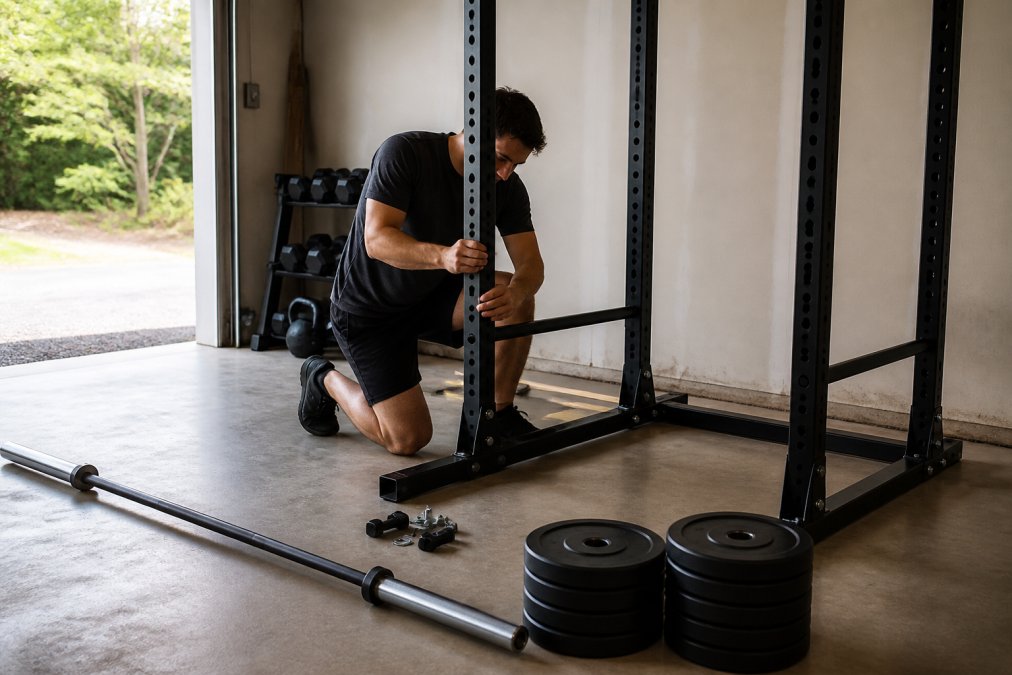
For beginners, the highest-return purchases are a squat rack, an adjustable bench, a barbell, and a set of weight plates. That combination covers the overwhelming majority of strength training movements and scales with you for years.
Must-Have Gear for Strength and Cardio
Buy in this order and you will not waste money on gear you outgrow:
- Squat rack or power cage - the anchor of every strength session
- Adjustable bench - flat, incline, and decline in one footprint
- Barbell and weight plates - buy plates incrementally as you get stronger
- Adjustable dumbbells - covers accessory work without a full rack of pairs
- One cardio machine - a rower or bike takes less floor space than a treadmill
Home Gym Maintenance Tips for Long-Term Durability
Basic maintenance is what separates a setup that lasts a decade from one that needs replacing in three years. The routine is short, and skipping it is the single most common reason home equipment degrades early.
- Wipe barbell shafts and sleeves after sweaty sessions to prevent corrosion
- Re-tighten rack bolts and bench hardware every few months
- Lubricate moving joints on cable machines per the manufacturer's schedule
- Inspect cables and straps for fraying before every heavy pull
- Keep a dehumidifier running in garages and basements
Psychological Barriers: Why Consistency Beats Convenience
The biggest predictor of whether a home gym pays off is not the equipment, it is whether you actually train in it. Convenience removes logistics, but it also removes the external structure that keeps many people consistent.
Resale Value and Depreciation of Home Gym Equipment
Resale value is the single line item that separates a home gym from a gym membership on a five-year spreadsheet, and almost no buying guide runs the math. A membership has zero residual value the day you cancel. Equipment does, but only if you bought the right categories. High-end racks and plates retain their worth far better than specialized professional recovery equipment, which often depreciates rapidly as newer technology renders older models obsolete.
- Free weights and plates, the strongest resale category. Cast iron does not fatigue, rust is cosmetic if caught early, and buyers actively seek used plates because new ones ship freight-heavy and expensive.
- Barbells and racks, strong resale if the brand is known and the finish is intact. Knurling wear and bent shafts are the two defects that kill value.
- Adjustable dumbbells, good resale, but the mechanism is the risk. Dial and pin systems that still index cleanly sell; ones that stick do not.
- Cable machines and functional trainers, fair resale. Buyers discount for cable stretch, pulley wear, and discontinued weight stacks.
- Treadmills, ellipticals, and console-driven cardio, weak resale. The motor, deck, and electronics all depreciate together, and shipping cost eats a large share of the sale price.
Three factors move resale more than age:
- Condition of wear surfaces. Barbell knurling, bench upholstery, cable sheathing, and treadmill belts. A ten-year-old rack in good shape outsells a three-year-old one stored in a damp garage.
- Brand recognition in the secondary market. Buyers search by name. Off-brand equipment sells at a steep discount because the buyer cannot verify replacement parts.
- Whether the original accessories survive. Collars, safety pins, J-cups, and hardware kits. Missing small parts are the most common reason a listing sits.
Space Cost-Per-Square-Foot: The Hidden ROI Factor
Every home gym occupies floor space, and floor space has a price whether or not you ever see it on a receipt. This is the cost line that separates a real long-term analysis from a shopping list, and it is the one most guides skip entirely.
- Measure the actual footprint. Include the rack, the bench when extended, the barbell's swing radius, and a clear walkway. A power rack with a barbell typically needs roughly a 10 ft by 10 ft zone to train safely, and a folding rack or wall-mounted setup can cut that substantially. Cardio machines add their own footprint on top.
- Estimate the annual value of that space. The cleanest proxy is what similar square footage rents for in your area, divided by twelve. If a comparable room rents for a known monthly figure, dividing that by the room's square footage gives you a per-square-foot monthly value you can apply to the gym zone.
- Multiply by your ownership horizon. Five years is the standard window for this comparison. Ten years is where the home gym case gets very strong, because the membership side keeps compounding and the space cost does not.
- Add it to the equipment cost, then compare to dues. This produces a true total cost of ownership rather than a sticker-price comparison.
The decision rule is what makes this useful:
- If the space has no realistic alternative use, a basement corner, an unfinished garage bay, a dead zone behind a couch, the space cost is effectively near zero and the home gym wins on almost any timeline.
- If the space displaces a room you would otherwise rent out, work from, or use as a bedroom, the space cost is real and recurring, and the home gym has to beat the membership by a wider margin to justify itself.
- If the space is in a high-cost, dense market, the per-square-foot value is high enough that a compact, folding, or vertical setup is not a style preference but a financial requirement.
Integrating Wearable Tech to Maximize Your Home Gym
Wearable tech closes part of the accountability gap that a commercial gym fills naturally. A watch or ring that tracks sessions, recovery, and heart rate gives you the external feedback a training partner would otherwise provide.
Frequently Asked Questions
What is the best home gym equipment in 2026?
For a well-rounded home gym, start with a squat rack, adjustable bench, barbell, and weight plates. Add a cardio machine like a rower or treadmill if space allows. Body Fuel Fury offers durable, affordable options for beginners. Focus on versatile pieces that support strength training and cardio to cover all fitness goals without overspending.
How does the long-term ROI of a home gym compare to a monthly membership?
The long-term ROI of a home gym versus a monthly membership depends on various factors, including equipment quality, local membership rates, maintenance, space considerations, and resale value. For consistent users, a home gym can offer significant long-term savings.
What are the hidden maintenance costs of home gym equipment?
Hidden costs can include replacing worn cables, lubricating moving parts, and cleaning upholstery. Cardio machines may need belt replacements or software updates. Proper maintenance, such as dusting and tightening bolts, can extend equipment life and protect your investment.
Is there a tax write-off for home gyms?
Generally, no. The IRS does not allow deductions for personal home gym equipment unless it is exclusively used for a qualifying medical purpose or as a home office for a fitness business. Consult a tax professional for your specific situation. Most home gym purchases are considered personal expenses.
The honest answer is that a home gym is worth it long term for people who will actually use it, and a poor investment for those who will not. Body Fuel Fury stocks the durable strength equipment, recovery tools, and performance supplements that make a home setup work from day one, backed by value-driven pricing and a customer-service team that helps you buy the right gear the first time. Browse the Body Fuel Fury range and build a setup that pays for itself.