 ultimate-guide
Why Quality Fitness Supplements Are Affordable
Table of Contents
- The Economics Behind Affordable Quality Supplements
- Best Supplements for Muscle Growth 2026: What Actually Works
- How to Identify Third-Party Tested Supplements
- Supplement Safety Standards and FDA Oversight
- Hype vs. Reality: What You Actually Need to Spend
- Manufacturing Transparency and Pricing Power
- Supplement Stacking for Maximum Value
- Frequently Asked Questions
Last Updated: September 1, 2026
The Economics Behind Affordable Quality Supplements
Quality fitness supplements affordable pricing exists because manufacturing scale, ingredient commoditization, and direct-to-consumer retail models have eliminated unnecessary markup layers.
Manufacturing scale is the primary driver. As demand for fitness supplements has grown, manufacturers have invested in larger production facilities that distribute fixed costs across millions of units. A facility running 24/7 to produce creatine monohydrate spreads overhead differently than one running a single batch per month, dramatically reducing per-unit costs that pass to consumers shopping at value-driven retailers like Body Fuel Fury.
Second, ingredient commoditization has transformed the market. Core ergogenic aids like creatine, whey protein, and beta-alanine are no longer exotic compounds. They're produced in bulk by multiple manufacturers globally, driving prices down without sacrificing efficacy. A quality fitness supplements affordable option today would have cost triple 15 years ago for the identical ingredient profile.
Third, the rise of direct-to-consumer retailers has eliminated intermediaries. Brands no longer need to sell through distributors, wholesalers, and brick-and-mortar chains, each taking their margin. Online retailers with lean overhead translate that efficiency directly to lower shelf prices.
Best Supplements for Muscle Growth 2026: What Actually Works
Most supplements deliver marginal results at premium prices. A focused stack of evidence-based supplements can drive meaningful muscle hypertrophy without excessive spending. Understanding the actual science matters more than following influencer recommendations, as marketing budgets often dwarf research budgets in supplement companies.
Creatine Monohydrate and Protein: The Cost-Effective Foundation
Creatine monohydrate is the single most researched and validated ergogenic aid in existence (peer-reviewed research). Decades of peer-reviewed research confirm its effectiveness for muscle hypertrophy, strength gains, and cognitive function. A typical dose is 5 grams daily, costing under $0.10 per day (the NIH).
Whey protein isolate or concentrate serves as the foundational macronutrient delivery system. Muscle protein synthesis requires adequate amino acid availability, particularly leucine. Protein powder offers convenience and cost efficiency, with per-serving costs dropping significantly as manufacturing scaled.
The combination of creatine monohydrate and whey protein creates the baseline for any serious muscle-building program.
Beta-Alanine and Nitrates: Performance Without Premium Pricing
Beta-alanine buffers intramuscular pH during high-rep training, extending performance capacity. A typical dose is 3-5 grams daily, making it particularly valuable for hypertrophy-focused training in the 6-15 repetition range.
Nitrates (from beetroot juice, sodium nitrate, or potassium nitrate) improve blood flow and oxygen delivery by increasing nitric oxide bioavailability. The evidence base is solid, and the cost is low, especially when buying powdered versions rather than fresh juice. Both ingredients have become commodity items as manufacturing has scaled.
How to Identify Third-Party Tested Supplements
Third-party testing is the verification mechanism that separates marketing claims from actual product integrity. Not all certifications are equivalent, and knowing how to read a label for authentic verification is essential to avoiding counterfeit or mislabeled products.
Understanding the Major Certifications
NSF Certified for Sport is the gold standard for athletes concerned about banned substances. NSF tests for over 270 banned substances on the World Anti-Doping Agency (WADA) list and NCAA prohibited substances list (nsf.org). The certification requires manufacturers to submit products for testing before marketing and again at random intervals. Look for the NSF logo on the front or back label.
Informed Choice focuses on contamination and label accuracy. The certification tests for banned substances but emphasizes ingredient verification and contaminant screening for heavy metals, microbial pathogens, and pesticide residues. Informed Choice is particularly valuable for supplements with botanical ingredients.
USP (United States Pharmacopeia) Verified confirms that a product meets manufacturing standards for identity, strength, purity, and composition. A USP-verified supplement contains the labeled ingredients in the labeled amounts.
Informed-Sport is a third-party testing program specifically for sports supplements that tests for banned substances and contaminants and is recognized by major sports organizations.
How to Verify Certifications on a Label
Legitimate third-party certifications appear as logos or seals on the product label, typically on the back or side panel. To confirm a certification is genuine:
-
Check the certifier's website. NSF, Informed Choice, and USP all maintain searchable databases of certified products. Enter the product name and manufacturer to confirm the certification is current.
-
Look for batch-specific information. Reputable certifications test specific batches. The label should reference a batch number or lot code that you can cross-reference on the certifier's database.
-
Verify the logo design. Compare the logo on the label to the official logo on the certifier's website. Official logos are high-resolution and match exactly.
-
Avoid vague claims. Phrases like "tested for quality" or "third-party verified" without a specific certifier name are marketing language, not verification. Legitimate certifications always name the organization.
The Cost-Quality Trade-Off
Third-party testing adds cost to manufacturing. A product with NSF Certified for Sport certification typically costs 10-15% more than an identical product without certification. However, this premium is justified for athletes and consumers who prioritize safety verification. For general fitness enthusiasts, Informed Choice or USP verification offers similar contamination protection at a lower price point.
Supplement Safety Standards and FDA Oversight
The FDA regulates dietary supplements under the Dietary Supplement Health and Education Act (DSHEA), which establishes baseline safety requirements. Manufacturers must ensure supplements are safe before marketing and must report adverse events to the FDA.
DSHEA requires that supplement manufacturers establish quality control procedures to ensure identity, purity, strength, and composition. A facility following Current Good Manufacturing Practices (cGMP) for supplements demonstrates adherence to these standards. This regulatory framework creates accountability, when contamination or safety issues arise, the FDA can issue recalls and take enforcement action.
Hype vs. Reality: What You Actually Need to Spend
The supplement industry's marketing machine creates artificial demand for expensive products with marginal benefits. Consider the common narrative around "premium" pre-workout formulas selling for $40-60 per container. These products often contain the same core ingredients, caffeine anhydrous, beta-alanine, and nitrates, as products costing $15-20. The difference is marketing spend, proprietary blends that hide dosage transparency, and celebrity endorsements. The ergogenic benefit is nearly identical.
The same pattern applies to protein powders. A $60 "premium" whey isolate and a $25 quality whey concentrate deliver similar results in a well-designed training program. Quality fitness supplements affordable pricing exists precisely because the core ingredients that drive results are commoditized. You don't need proprietary formulas or exotic compounds, you need evidence-based doses of proven ingredients.
Manufacturing Transparency and Pricing Power
Transparency in sourcing and manufacturing directly enables affordable pricing. Most consumers assume "transparency" is a marketing buzzword. In reality, it's a structural advantage that reduces costs across the supply chain.
How Supply Chain Structure Affects Price
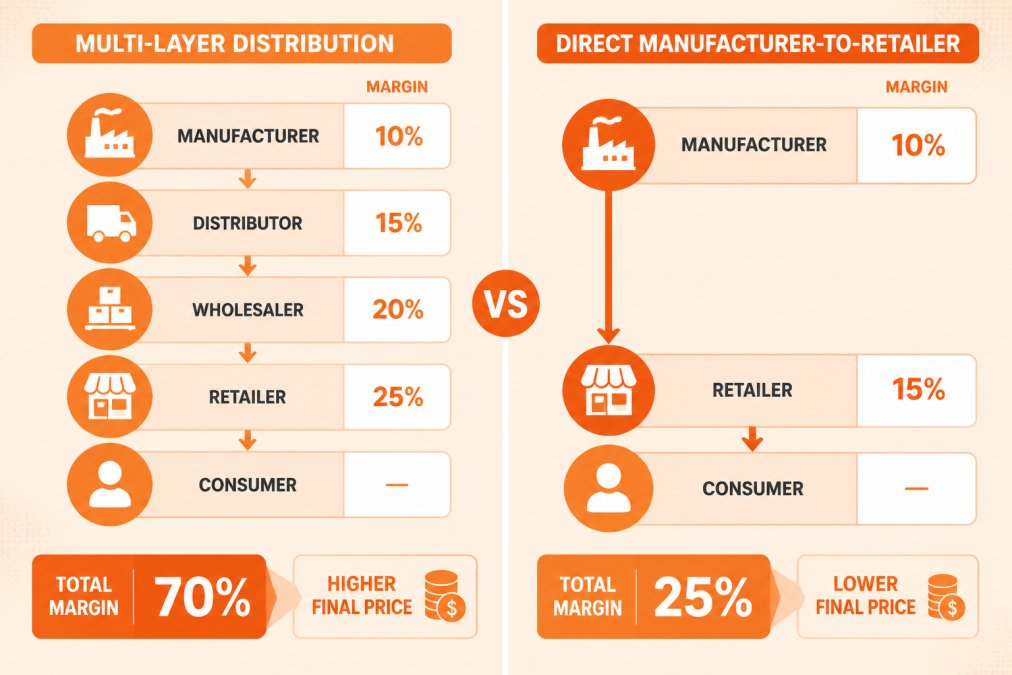
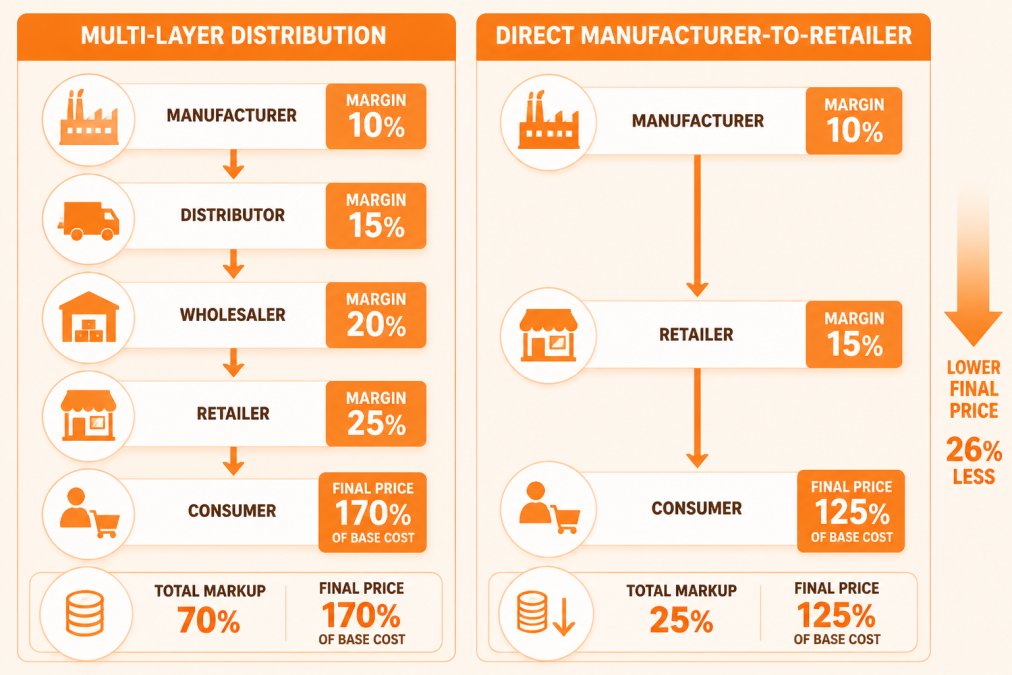
Most supplement retailers operate through a multi-layer distribution model: manufacturer → distributor → wholesaler → retailer → consumer. Each layer takes a margin, typically 20-40%. A supplement that costs $5 to manufacture might sell to a distributor for $7, to a wholesaler for $9, to a retailer for $12, and to a consumer for $25.
Retailers committed to direct manufacturer relationships eliminate these intermediary layers. When a retailer works directly with a manufacturer, they negotiate volume pricing and skip distributor and wholesaler markups. A $5 manufacturing cost might move directly to a $12-15 retail price instead of $25. The product is identical; the supply chain is shorter.
Current Good Manufacturing Practices (cGMP) and Verification Costs
The FDA requires supplement manufacturers to follow Current Good Manufacturing Practices (cGMP), which establish standards for facility design, equipment maintenance, personnel training, and quality control documentation. Retailers with long-term direct relationships with manufacturers can amortize verification costs across larger volumes. A retailer buying 100,000 units annually from a single manufacturer spreads the audit cost across those units, reducing the per-unit verification expense to pennies.
Transparency enables efficiency: retailers that publicly commit to cGMP-verified sourcing have incentives to maintain those relationships and negotiate volume pricing that justifies the verification investment.
Ingredient Sourcing and Commodity Pricing
Core supplement ingredients like creatine monohydrate, whey protein concentrate, and beta-alanine are commodities produced by multiple manufacturers globally. Retailers with transparent sourcing relationships can negotiate commodity pricing directly with manufacturers. They know the current market price for creatine monohydrate (typically $2-4 per kilogram in bulk) and can verify that a manufacturer's pricing is competitive.
For example, a retailer buying creatine monohydrate directly from a manufacturer at $3 per kilogram can produce a 5-gram serving for approximately $0.015 in ingredient cost. Transparent sourcing allows retailers to pass commodity pricing directly to consumers.
The Transparency Premium (or Lack Thereof)
A common misconception is that transparent retailers charge a premium for their transparency. In reality, the opposite is true. Transparent retailers have structural incentives to maintain competitive pricing because their sourcing is verifiable. If a transparent retailer's prices are significantly higher than competitors, customers can investigate why and shop elsewhere.
Supplement Stacking for Maximum Value
Strategic stacking, combining multiple supplements that work synergistically, maximizes results without proportional cost increases. The foundational stack for muscle growth is creatine monohydrate, whey protein, and a multivitamin. This combination addresses the core requirements for muscle protein synthesis and micronutrient sufficiency. Total monthly cost is typically $30-50.
Adding beta-alanine and a caffeine-based pre-workout extends performance capacity and training volume. These additions cost another $15-25 monthly. Beyond this foundation, additional supplements show diminishing returns. Branched-chain amino acids, for example, are redundant if you're already consuming adequate whole protein.
When shopping for a stacked supplement regimen, retailers offering bulk pricing on core ingredients provide the best value. Body Fuel Fury's commitment to value-driven pricing means you're not paying premium markups on the foundational supplements that actually drive results.
Quality fitness supplements affordable is not a contradiction. It's the natural result of market maturation, manufacturing scale, and retail models built on transparency rather than margin maximization. The core ingredients that drive muscle growth, creatine monohydrate, whey protein, beta-alanine, and nitrates, are commoditized, well-researched, and inexpensive. Third-party testing verifies safety without requiring premium pricing. Strategic stacking maximizes results without unnecessary complexity.
Shop with retailers committed to transparency and direct manufacturer relationships, prioritize evidence-based ingredients over marketing claims, and verify third-party testing certifications. Body Fuel Fury's years of industry experience and customer-service-oriented approach ensure you're getting verified quality at prices that don't require compromise. Shop Now and build your supplement stack with confidence.
Frequently Asked Questions
How can I verify the quality of affordable fitness supplements?
Look for third-party testing certifications from organizations like NSF Certified for Sport or Informed Choice on the label. Check the ingredient list for proprietary blends versus transparent dosages. Visit the manufacturer's website to confirm they follow FDA guidelines for supplement manufacturing. Request certificates of analysis if available. Affordable supplements can be high-quality when produced at scale by reputable manufacturers who prioritize transparency over marketing hype.
Are generic fitness supplements as effective as name-brand products?
Effectiveness depends on ingredient quality and dosage, not brand name. A generic creatine monohydrate supplement with third-party testing performs identically to premium versions because the active compound is the same. The price difference often reflects marketing budgets, not superior formulation. Compare the amino acid profile, bioavailability, and testing certifications rather than brand reputation. Many affordable options deliver the same performance metrics as expensive alternatives.
What factors contribute to the price of fitness supplements?
Manufacturing scale, packaging, marketing spend, and distribution channels drive costs. Brands that produce larger batches reduce cost-per-serving through economy of scale. Minimal packaging and direct-to-consumer sales lower overhead. Premium brands invest heavily in celebrity endorsements and influencer partnerships, inflating prices without improving the product. Third-party testing adds cost but signals quality. Proprietary blends often hide cheaper filler ingredients, masking true value.
Do I really need expensive supplements to see muscle growth?
Muscle hypertrophy depends on progressive resistance training, adequate protein intake, and caloric surplus, not supplement cost. Evidence-based supplements like creatine monohydrate and whey protein support these fundamentals affordably. Expensive proprietary blends rarely outperform basic, tested compounds. Whole food alternatives like eggs, chicken, and Greek yogurt provide amino acid profiles comparable to high-cost powders. Budget constraints should not prevent you from accessing effective ergogenic aids; affordable options with third-party testing deliver measurable results.