 how-to
Why You Need a Dedicated Workout Space
Table of Contents
- Why a Dedicated Workout Space Changes Your Fitness Results
- How Much Space Do You Need for a Home Gym
- Home Workout Space Ideas for Any Room
- Home Gym Equipment Essentials to Start
- How to Create a Home Gym in 5 Steps
- Safety, Ventilation, and Comfort Matter
- Frequently Asked Questions
Last Updated: October 14, 2026
Why a Dedicated Workout Space Changes Your Fitness Results
A dedicated workout space is one of the most underrated tools for building lasting fitness habits. It removes friction, signals commitment to your brain, and makes consistency effortless. A dedicated workout space can help countless individuals transform their fitness journeys simply by carving out a corner, or an entire room, where they could move without excuses.
The real power isn't the equipment. It's the psychology. When your workout space exists, you don't have to decide where to exercise. You don't have to move furniture. You don't have to convince yourself it's worth the setup time. You just show up.
Here's what separates people who stick with fitness from those who quit: removing barriers between intention and action. A dedicated space does exactly that.
How Much Space Do You Need for a Home Gym
You don't need much. Most people can build a functional workout space in as little as 50 square feet. That's roughly the size of a closet. For cardio equipment like a treadmill or exercise bike, plan for about 7 feet by 4 feet. Add another 6 feet of clearance in front if you want room to move safely.
The real question isn't "How much space do I have?" It's "What will I actually use?"
A treadmill demands more floor space than free weights. Functional training, bodyweight movements, kettlebell work, resistance bands, requires open space to move in multiple directions. If you're doing yoga or stretching, you need room to extend your arms and legs without hitting walls.
Here's a practical breakdown:
- Minimal setup (resistance bands, dumbbells, yoga mat): 50-80 square feet
- Moderate setup (weights, bench, some cardio): 100-150 square feet
- Full gym (multiple cardio machines, free weight rack): 200+ square feet
The key is honest assessment. Don't plan for equipment you won't use. Start small. Add as your routine solidifies.
Home Workout Space Ideas for Any Room
Spare Bedroom or Den
A spare bedroom is ideal. It's private, typically has a door you can close, and already feels like a dedicated space. This psychological boundary matters more than you'd think.
Paint or decorate it differently from the rest of your home. Add a mirror if possible, it helps with form and makes the space feel larger. Good lighting (natural or bright overhead) keeps energy up. Poor lighting drains motivation faster than almost anything else.
Flooring is worth considering. Carpet works for yoga and bodyweight training but can be hard on joints during high-impact work. Rubber mats or interlocking foam tiles protect both your body and the floor beneath. They also reduce noise if you have neighbors or family below.
Temperature matters. A basement gym stays cool in summer but can feel damp. An upstairs room gets hot. Ensure air flows through the space, or you'll dread working out there.
Garage Gym Setup
Garages are popular for good reason: they're already separate, typically have concrete floors, and offer room to expand. The downside? They're often cold, poorly lit, and lack climate control.
Invest in basic solutions:
- Add insulation or weatherstripping if winters are harsh
- Install bright overhead lights, LED panels are affordable and effective
- Use rubber flooring to protect your joints and reduce noise
- Set up a small heater or fan depending on your climate
Garages also attract clutter. Keep your workout area distinct from storage. A simple rope or tape line on the floor works. When your gym space is visually separate, you're more likely to protect it from becoming a junk room.
Corner of a Living Space
Not everyone has a spare room. A corner of a bedroom, living room, or even a hallway works. The trick is making it feel intentional, not like equipment scattered around.
Use a room divider, curtain, or even a bookshelf to define the boundary. This creates a psychological shift: when you step into that corner, you're "at the gym." When you step out, you're done.
Keep it minimal. A yoga mat, a set of dumbbells, a resistance band, and a pull-up bar (if your ceiling allows) occupy almost no space but enable dozens of exercises.
Home Gym Equipment Essentials to Start
You don't need much to begin. The best equipment is what you'll actually use, and the smartest way to build a home gym is in tiers, adding only after the previous tier has proven itself in your routine.
Tier 1: The Starter Setup
This is where almost everyone should begin. It covers strength, mobility, and conditioning with almost no footprint.
- Dumbbells or kettlebells, versatile, space-efficient, work every muscle group
- Resistance bands, cheap, portable, surprisingly effective for warm-ups and accessory work
- Yoga mat, protects your joints and visually defines your workout zone
- Pull-up bar, optional but powerful for upper body work if your doorway or ceiling allows
A common pattern is that people who start here stick with it longer than people who buy a rack and a treadmill in week one. The reason is simple: less equipment means less setup friction, and setup friction is the number-one killer of home workouts.
Tier 2: The Mid-Range Build
Add these only after you've used your Tier 1 gear consistently for at least a month and know which movements you actually enjoy.
- An exercise bike, rower, or jump rope for cardio
- An adjustable bench for pressing and step-up movements
- A set of heavier dumbbells or a kettlebell in a second weight
- A mirror to check form
Tier 3: The Full Setup
This tier is for people who have already proven they train at home multiple times per week and want to stop compromising.
- A barbell and rack if you lift heavy
- A dedicated cardio machine (treadmill, rower, or bike)
- Plate storage and a wall-mounted rack to keep the floor clear
What You Can Repurpose Instead of Buying
Before you add anything to a cart, walk your home and ask what already works:
- A sturdy chair or step stool can substitute for a bench for step-ups and dips
- A backpack loaded with books or water bottles works as a weighted vest or makeshift kettlebell for many movements
- A towel or folded blanket replaces a mat for floor work
- A doorway or sturdy beam can host a cheap pull-up bar instead of a full rig
The Cost Trade-Off Versus a Gym Membership
The honest comparison isn't "home gym versus free." It's home gym versus the recurring cost of a membership you may or may not use. A starter setup of bands, a mat, and one pair of dumbbells typically costs less than a few months of a mid-range gym membership, and it's a one-time purchase you keep. The mid-range and full tiers cost more upfront, but they replace a monthly fee permanently, and they remove the commute, the wait for equipment, and the scheduling friction that causes most people to stop going.
The mistake most people make is buying too much too soon. You end up with equipment you don't use, cluttering your space and draining your motivation. Body Fuel Fury stocks all these essentials at affordable prices, so you can build your space gradually without financial pressure.
How to Create a Home Gym in 5 Steps
This is the part most guides skip: the actual measurements and clearances that determine whether your space works or feels cramped. Follow these steps in order.
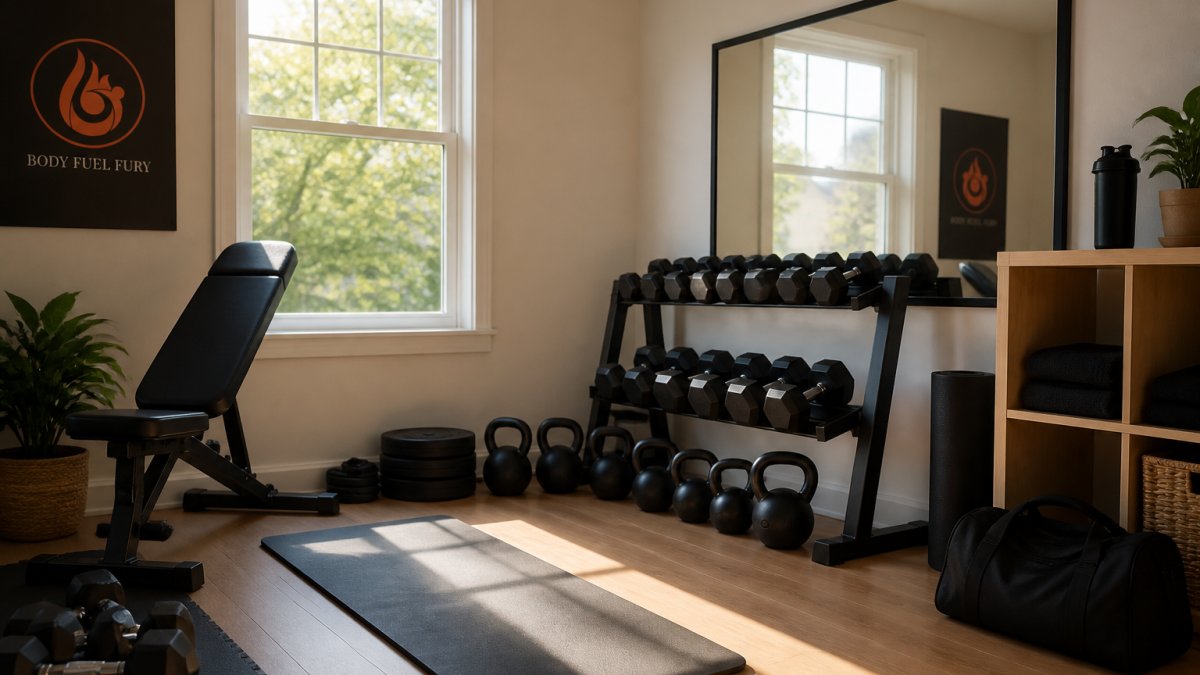
Step 1: Pick Your Location
Choose a room or corner that feels separate from your daily living space. It should be reasonably quiet and private. Temperature matters, too, too hot or too cold and you'll avoid it.
Step 2: Measure Your Space, and Your Clearances
Write down length, width, and ceiling height. Then account for doorways, windows, and obstacles. But don't stop at the room dimensions, measure the clearances you'll actually need around each piece of equipment:
- Treadmill or exercise bike: plan roughly 7 feet by 4 feet for the machine, plus about 6 feet of clearance in front and 2 feet on each side for safe mounting and dismounting.
- Free weights and a bench: allow at least 3 feet of clearance on all sides of the bench so you can load plates and bail out safely.
- Functional and bodyweight training: you need enough open floor to extend your arms and legs fully in every direction without hitting a wall, roughly a 6-by-6-foot clear zone as a starting point.
- Ceiling height: if you plan to do overhead presses, jump rope, or pull-ups, measure the ceiling. A pull-up bar needs enough clearance above it for your full reach.
A simple method: use painter's tape to mark the footprint of each machine and the clearance zone around it on the floor.
Step 3: Choose Your Core Equipment
Decide what you'll actually do. Will you lift weights? Do cardio? Yoga? Pick two or three types of movement, then buy equipment for those only.
Step 4: Set Up Flooring
Protect your joints and your floor.
Step 5: Add Light and Mirrors
Good lighting transforms the space. Bright, even overhead lighting works best, avoid harsh shadows or flickering bulbs. A mirror helps with form and makes a small room feel bigger.
Safety, Ventilation, and Comfort Matter
A dedicated workout space should feel good to be in. Neglecting basics like air quality and lighting turns your gym into a place you avoid.
Ventilation matters more than most people realize. A stuffy room gets hot, feels oppressive, and makes workouts harder. Open a window. Use a fan.
Flooring prevents injury. Concrete without padding is hard on your knees and back. Carpet alone doesn't provide enough support.
Temperature affects performance. Too cold and your muscles stay tight. Too hot and you fatigue faster. Aim for 65-70°F if possible.
Noise control matters if you share walls or floors. Rubber flooring absorbs sound. Heavy equipment on concrete creates impact noise that travels.
Lighting shouldn't be overlooked. Poor lighting drains energy and makes form harder to check. Bright, even overhead lighting works best. Avoid harsh shadows or flickering bulbs, they're distracting and exhausting.
A dedicated workout space removes the biggest barrier to consistency: friction. You don't need much, a corner, some basic equipment, and decent lighting.
Frequently Asked Questions
What are the benefits of having a dedicated workout space at home?
A dedicated workout space removes barriers to exercise by eliminating setup time and travel delays. You're more likely to work out consistently when your equipment is ready and your environment is designed for fitness. A dedicated space also creates mental separation from daily distractions, helping you stay focused during your workout. Many people find that having a space that's theirs for fitness boosts motivation and makes it easier to maintain a regular routine.
How much space do you need for a home gym?
A functional home gym can work in as little as 50-100 square feet. For cardio equipment like a treadmill or exercise bike, plan for at least 6 feet of clearance in front and behind. Strength training with free weights needs open floor space for movement and safety. If space is tight, focus on versatile equipment like adjustable dumbbells and resistance bands that take up minimal room. Vertical storage and wall-mounted racks help maximize small areas.
How can a dedicated workout area help you stay consistent?
Consistency improves when friction decreases. A dedicated space means no furniture to move, no equipment to set up, and no excuses about convenience. When your workout area is always ready, you're more likely to exercise on busy days. The psychological effect of having a space designated for fitness also reinforces your commitment. Research on habit formation shows that environmental cues (like a dedicated space) strengthen routine behavior over time.
What equipment do you need for a basic home workout space?
Start with adjustable dumbbells, a yoga mat, and resistance bands, these cover strength and flexibility training in minimal space. Add a pull-up bar if you have a doorway, and consider a bench for pressing exercises. For cardio, an exercise bike or rowing machine takes up less space than a treadmill. As your fitness grows, add equipment that matches your goals. The key is choosing versatile, durable gear that supports multiple exercises.